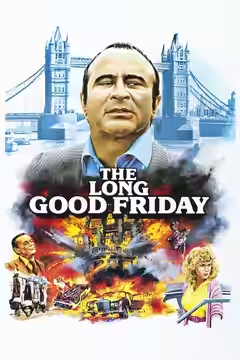
John Mackenzie’s strongest work makes crime feel like a business conducted by recognisable people in recognisable places. We rate his judgement of actors and character highly, though his images are not always as lively as his dialogue.
Fi1m perspective
Harold Shand makes criminal ambition sound like a sensible business proposition in The Long Good Friday (1980). John Mackenzie lets Bob Hoskins be funny and persuasive without asking us to admire Harold’s violence. We laughed at his respectable business talk, then felt uneasy about how readily Hoskins had won us over. Mackenzie is good at giving an actor room for those contradictions, and this is the film we would start with.
His work as Ken Loach’s assistant helped establish a practical method: real locations and local or non-professional actors. The early feature Unman, Wittering and Zigo (1971) took him into psychological suspense, while his television collaborations with writer Peter McDougall included Just a Boy's Game (1979). His profile rose with A Sense of Freedom (1979), about Scottish gangster Jimmy Boyle. His recurring subjects were crime and working-class life, particularly in Scotland and London.
That attention to place pays off in The Long Good Friday. Cinematographer Phil Meheux uses the worn London buildings to make Harold’s ambitions seem practical: somebody could see an opportunity to make money here. Barrie Keeffe’s script gives him the language to dress those ambitions up as respectable enterprise. Mackenzie trusts us to notice what is wrong with the proposition, without making Harold too repellent to spend an evening with.
Mackenzie does not always find images as lively as Keeffe’s dialogue, and the plotting can become tangled. Francis Monkman’s emphatic synthesiser score supplies some of the urgency that the comparatively stolid photography lacks. The actors do enough to keep us interested, but a little more clarity would have helped.
His later international features, including The Honorary Consul (1983), were less distinctive than the British work. Yet Ruby (1992) drew the strongest reviews of his American period; there is reason to look beyond the obvious title. We would still begin with The Long Good Friday, preferably on an evening without interruptions. Harold’s business is complicated enough without attending to our own.