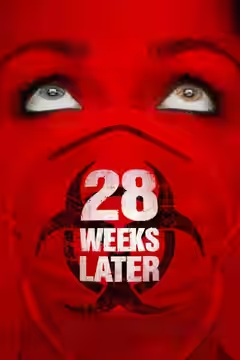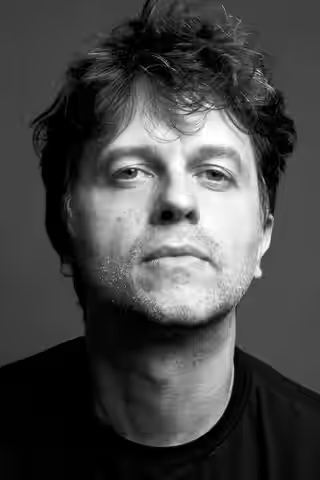
A director of sequences. When the set piece is running, as in the night-sight tube station of 28 Weeks Later, few in horror do it better; between the set pieces, his people and his plots have a habit of going thin.
Fi1m perspective
There is a stretch in 28 Weeks Later (2007) in which we see only what a rifle's night sight sees: a tube station, green and grainy, bodies where the light catches them and nothing where it does not. We were frightened in a way the plot had not earned and the staging had, and we have not forgotten it. That is Juan Carlos Fresnadillo in one shot. He builds a sequence out of one light source, one confined space and one rule about what can be seen, and holds it until we want out.
He came up through short films and commercials in Spain, and his first feature, Intacto (2001), which he also wrote, is about luck, survival and catastrophe, which turns out to be the whole career in three words. 28 Weeks Later was the one that travelled: Danny Boyle's Britain six months on, a fenced compound, a curfew, an American soldier on every roof. Since then the pattern has been long gaps. Intruders (2011), a psychological horror about family secrets told across two stories; television episodes; projects announced and never made; and then Damsel (2024), a fairy tale reworked around a woman trying to stay alive. The producer Enrique López Lavigne has been with him for three of these films, and shares the screenplay credit on the sequel.
What works is the staging. 28 Weeks Later opens with the best ten minutes in either film, and later finds a room lit only by muzzle flash and a use for a helicopter that helicopters are not meant for. In 2007, a film about an occupying army losing control of a city it promised to rebuild did not need a caption, and he had the sense not to add one. Robert Carlyle, working mostly with a face that has decided not to feel anything, gives him the best acting he has had.
What does not work is everything the sequences hang from. The screenplay needs two children on a moped to cross a sniper-watched perimeter in daylight, and later needs two adults to change sides in a single cut, and it does not care how either happens. The film has eight characters and time for about two, and Gill's cutting is so fast that we occasionally lost who was still alive, not always on purpose. The reviews of Intruders said much the same thing: strong pictures, thin story. Fresnadillo has talked about that film growing out of childhood nightmares he later connected to his own family's secrets, and the theme of inherited fear turning into something with teeth is his most consistent one. He is more interested in what a family passes down than in the people it passes it to, and it shows.
Start with 28 Weeks Later, at night, with the sound up, and forgive the moped. If Damsel is the beginning of a steadier run, the survival instinct was always there; it is the people he needs to keep alive between the set pieces.
Biography
Juan Carlos Fresnadillo is a Spanish film director, screenwriter and producer. Born on 5 December 1967 in Santa Cruz de Tenerife in the Canary Islands, he moved to Madrid in 1985 to study sociology, photography and cinema.
His short film Esposados (1996) was nominated for the Academy Award for Best Live Action Short Film. He made his feature debut with the thriller Intacto (2001), for which he received the Goya Award for Best New Director.
Fresnadillo directed and co-wrote the screenplay for 28 Weeks Later (2007), the sequel to Danny Boyle's 28 Days Later. His subsequent feature films include Intruders (2011) and Damsel (2024).