Karen Morley’s smooth voice makes her sharp replies particularly satisfying. We recommend her as Poppy in Scarface first: a sensual, quick-witted performance that gives good reason to pay attention beyond the gangsters.
Fi1m perspective
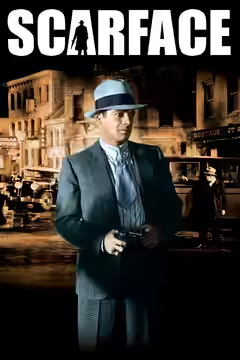
Karen Morley’s smooth voice is an agreeable way to deliver a sharp reply. In Howard Hawks’s Scarface (1932), her Poppy combines sensuality with a wit that makes the gangster’s moll a part worth listening to. We laughed at her sharp talk; Morley makes Poppy’s humour as much a pleasure as her glamour. Being desirable does not require her to be accommodating. That independence gives us a reason to watch her beyond her place in the plot, and makes Poppy a persuasive introduction to her work.
There is useful work in the supporting credits, too. Mata Hari (1931) placed her opposite Greta Garbo as Carlotta, while George Cukor’s Dinner at Eight (1933) cast her as Lucy Talbot in its ensemble. The dependable supporting actor matters here, even if those parts are less immediately distinctive than Poppy. We would be reluctant to recommend a whole film merely because Morley appears in it, but her ensemble work gives us reason to look beyond the sharp-talking roles.
The change from MGM contract work to freelancing in 1934 brought a different sort of opportunity. In King Vidor’s Our Daily Bread (1934), she plays Mary Sims in a drama about a farming cooperative, with grounded acting that helps make its concerns human. Michael Curtiz’s Black Fury (1935) reunited her with Paul Muni, who also appears in Scarface. Her later supporting role as Mrs Collins in Pride and Prejudice (1940) gives another indication of how much work lay outside the molls and dangerous women.
For a first encounter, though, our recommendation remains Scarface. Its moral lectures interrupt the momentum, but Hawks’s vicious humour and the acting give ample compensation; we recommend it for those immediate pleasures rather than as a history lesson. George Raft’s restraint is one of them, and Morley’s sharp-witted sensuality belongs in the same company. Give Poppy as much attention as the men: her replies are part of the entertainment, not a pause while the gangsters prepare to resume.
Biography
Karen Morley was an American actor. Born Mildred Linton on 12 December 1909 in Ottumwa, Iowa, she studied at UCLA and trained at the Pasadena Playhouse before entering films.
She gained notice in early roles including Mata Hari (1931) and played Poppy opposite Paul Muni in Howard Hawks’s Scarface (1932). Under contract at MGM she appeared in The Mask of Fu Manchu (1932) and Dinner at Eight (1933). After leaving the studio in 1934 she worked freelance on films such as Our Daily Bread (1934) and Pride and Prejudice (1940).
Her screen career ended in the late 1940s after she refused to answer questions before the House Un-American Activities Committee. She later appeared in television series including Kung Fu (1972) and Kojak (1973). Morley died on 8 March 2003.