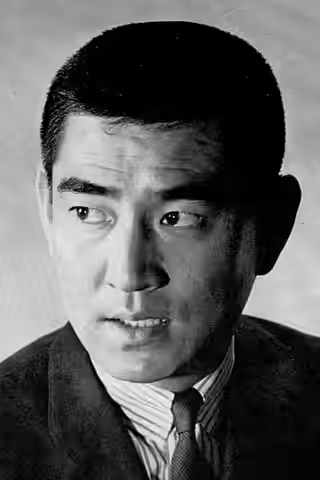
Ken Takakura makes a quiet man worth watching, using glances and posture to suggest what he will not say. We rate that restraint highly, even when his films settle for giving us another honourable outsider.
Fi1m perspective
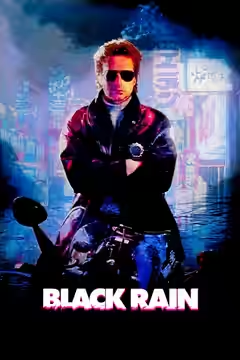
In Black Rain (1989), Ken Takakura's Masahiro looks as though he is considering what is happening rather than waiting to deliver his next line. His restraint gives a familiar police story someone worth paying attention to, without asking the film to stop for him. We warmed to Masahiro because we could watch him thinking without being told what every thought meant. Takakura makes that quietness feel natural, and the film is steadier for having him in it. It also makes the script's broad treatment of Japan harder to forgive.
That quietness was already central to the honourable outsiders who made him a star in Toei's chivalrous yakuza films of the mid-1960s. Abashiri Prison (1965) established him as an ex-con antihero and began a long-running series. He could suggest duty through a glance or the way he held himself, although repeated versions of the stoic outsider risked becoming too familiar. Sydney Pollack's The Yakuza (1974), alongside Robert Mitchum, brought that manner to an international production.
The move towards character-led drama suited an actor who could suggest feeling through small physical details. Yoji Yamada's The Yellow Handkerchief (1977) was an important part of that turn. His continuing work with director Yasuo Furuhata, including Station (1981) and Railroad Man (1999), made loneliness and duty recurring concerns. The sentimentality of Railroad Man also exposes a limitation: Takakura can hold back while the film around him presses too hard for our tears.
Ridley Scott gets the benefit of that discipline in Black Rain, but does too little with it. Takakura suggests a person with more to say than the script is prepared to explore; the film's cultural contrasts remain broad when his performance offers the chance to be specific. That is why we would separate our admiration for the actor from our qualified interest in the film. Even its strongest performance cannot repair that writing. Try it for him if a familiar police story will do for the evening.
Biography
Ken Takakura (高倉 健), also credited as Goichi Oda, was a Japanese actor who appeared in over 200 films. Born Takeichi Oda on 16 February 1931 in Nakama, Fukuoka, he graduated from Meiji University in Tokyo and joined the Toei Film Company after an impromptu audition in 1955. He made his screen debut in 1956 and became a leading figure in Japanese cinema through yakuza and action roles, notably in the Abashiri Prison series from 1965.
Takakura left Toei in 1976. He gained international recognition for roles in Hollywood productions including Too Late the Hero (1970), The Yakuza (1974) and Black Rain (1989), in which he played police inspector Masahiro opposite Michael Douglas. Later credits include Mr. Baseball (1992), Railroad Man (1999) and Riding Alone for Thousands of Miles (2005). He received the Japan Academy Prize for Outstanding Performance by an Actor in a Leading Role four times and was awarded the Order of Culture in 2013. Takakura died in Tokyo on 10 November 2014.