Kon Ichikawa began as an animator and composed films as an illustrator fills a page: one figure off to the side, dark all around it. The fifteen years with Natto Wada writing are the reason to know his name, and we rate them highly.
Fi1m perspective
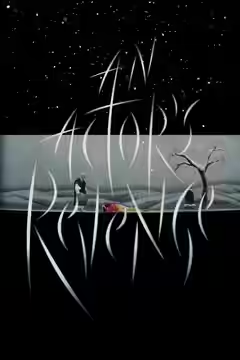
Look at almost any frame of An Actor's Revenge (1963) and you can see the joins. The street is painted, the moon is a lamp, and a thief sits above the story telling us what to make of it. Most directors who borrow from the theatre hide the wires; Ichikawa lights them. He started in the animation department of J.O. Studio in Kyoto in 1933, and his first film as director, A Girl at Dojo Temple (1946), used puppets. "I'm still a cartoonist," he told Donald Richie, and that is how he composes: a figure placed off to one side of a wide frame, with a great deal of dark or colour left around it.
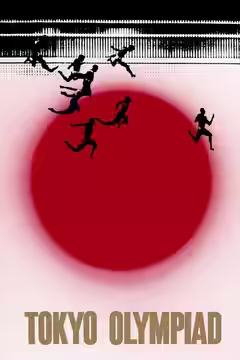
The films that matter were made between 1950 and 1965, with his wife Natto Wada writing; they made twenty-eight together. The Burmese Harp (1956) is a soldier who puts on a monk's robes to bury the dead. Conflagration (1958) is Mishima, obsession and destruction. Fires on the Plain (1959) takes Japanese soldiers in the Philippines a long way past hunger. Then the kabuki melodrama, and then Tokyo Olympiad (1965), a record of the 1964 Games that looks at effort and loss rather than heroes. Wada stopped writing. He went on working into the 2000s, with thrillers such as The Inugami Family (1976), adaptations such as The Makioka Sisters (1983) and a 1985 remake of The Burmese Harp, and died in Tokyo in 2008.
The usual complaint is that a man who made war films, a Mishima adaptation, a kabuki melodrama and a sports documentary in one decade cannot have a style, and was a craftsman rather than an author. We think this gets him backwards. The style is the subject: one person set apart from everyone else, and a camera that watches how long they last, whether the soldier, the actor in a woman's robe or the athlete who has lost. What he did not much care for was plot. The middle of An Actor's Revenge, all rice prices and rumour, goes slack because he is more interested in where the light falls than in who is being ruined, and we lost the thread and did not mind. What we did mind, more than we expected, were the scenes in which Kazuo Hasegawa's Yukinojo courts Ayako Wakao's Namiji in a woman's voice, meaning every gentle word as a lie; Ichikawa neither softens it nor points at it, and Wakao's face does the rest. The widescreen frame he liked was lit for him, film after film, by Setsuo Kobayashi and Kazuo Miyagawa, and cut by Chizuko Osada.
Start with An Actor's Revenge, in a dark room, since half the picture is black and a lamp behind you will fill it. Go on to the war films if you can bear them. The later decades are handsome and mostly routine, the same eye with less to look at, and you can leave them until you have run out of the others.
Biography
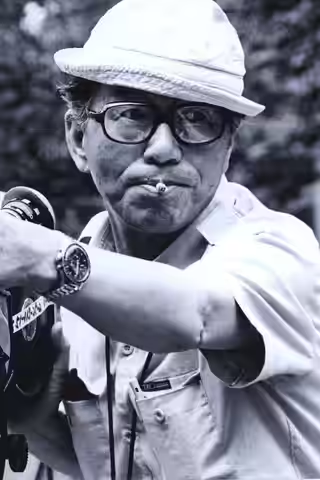
Kon Ichikawa (1915–2008) was a Japanese film director and screenwriter. He began his career in animation in the 1930s before moving into live-action directing in the 1940s.
He is known for a wide range of films, including the anti-war drama The Burmese Harp (1956), the period revenge story An Actor's Revenge (1963), and the documentary Tokyo Olympiad (1965), on which he also received a writing credit. The latter won two BAFTA Film Awards. Ichikawa often collaborated with his wife, screenwriter Natto Wada, on screenplays during the 1950s and 1960s.