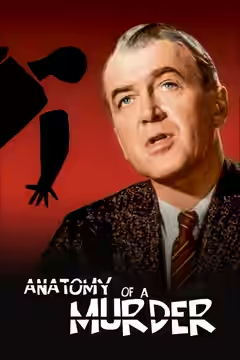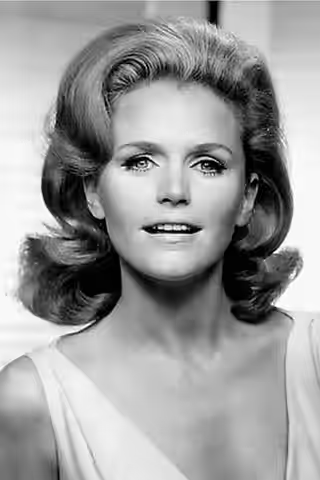
Lee Remick played women who were looked at, and let us watch them notice. Critics called the style natural and unmannered; Hollywood never worked out how to sell it. Anatomy of a Murder is where to start.
Fi1m perspective
Watch what Lee Remick does in Anatomy of a Murder (1959) while everyone else is watching her. Laura Manion is the wife the whole trial is about, and the film's camera looks at her the way the bar did; the questions, over and over, are what she was wearing and how she behaved. Remick plays her as bored, frightened and pleased to be looked at all at once, which is more than the writing gives her. We ended up more on her side than Preminger seemed to intend, because the fright is always there under the boredom and the pleasure, and she never lets us forget it. Nobody else in the film is doing anything that delicate, and nobody in it notices she is.
That was the breakthrough, though not the start. She came out of Broadway and the live television dramas of the mid-1950s, and Elia Kazan gave her a film debut in A Face in the Crowd (1957) and then a young widow in Wild River (1960), the plainest example of the thing critics kept noticing about her: she did not appear to be acting. Days of Wine and Roses (1962), for Blake Edwards and opposite Jack Lemmon, is the role most people remember, an alcoholic wife she prepared for with the kind of research that does not show on screen, which is the point of it. Then the film career stalled. The performances went on being praised; the films around them did not catch on, and she was by all accounts poor at selling herself, which in Hollywood is a fault.
She moved to England in 1970 and did most of her best-known later work for television, with the title role in Jennie: Lady Randolph Churchill (1974) and, back in cinemas, The Omen (1976). She returned to the United States in the early 1980s and kept working in television until her death in 1991. It is a working actor's career rather than a star's, and she seems to have preferred it that way: "I don’t quite know what stardom means. It was never something I went after, as such. I love to work… and I love trying to do the best."
Her habit, if she had one, was to be cast as a sensual woman under pressure and then to decline to play the sensuality as the point. What critics called natural can read, in the wrong film, as simply quiet; she needed a director who would let the pressure build, and Preminger, Kazan and Edwards did. The films we have not reviewed we will leave to their own pages. Start with the one we have, and keep your eye on the woman at the edge of the courtroom while the men talk about her.
Biography
Lee Remick was an American actress. She made her film debut in A Face in the Crowd (1957) and first gained major attention for her role as Laura Manion in Anatomy of a Murder (1959). Other early film roles include The Long, Hot Summer (1958), Wild River (1960) and Days of Wine and Roses (1962).
Remick received an Academy Award nomination for Best Actress for Days of Wine and Roses. She was also nominated for a Tony Award for Best Actress in a Play for her Broadway performance in Wait Until Dark (1966). She won Golden Globe Awards for the television film The Blue Knight (1973) and the miniseries Jennie: Lady Randolph Churchill (1974), for which she also received a BAFTA Television Award for Best Actress. Later film roles include The Omen (1976) and The Europeans (1979). In 1991 she was awarded a star on the Hollywood Walk of Fame.
Born in Quincy, Massachusetts, Remick trained in dance and began her career on stage and television before moving into film. She worked in both cinema and television throughout her career until the late 1980s.