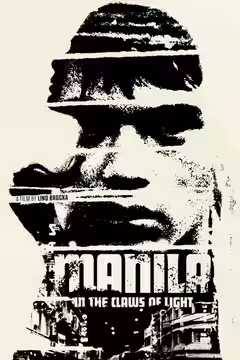
Lino Brocka made melodramas that keep a ledger. In Manila in the Claws of Light and the films around it, ordinary people are worn down by the city and then somebody counts the money, and the anger in them has not cooled.
Fi1m perspective
A man falls from the scaffolding in Manila in the Claws of Light (1975) and Lino Brocka does not cut away. A few minutes later the site is working again and the wage is what it was. That is his method in one scene: the terrible thing, then the ledger. He shot in Manila's streets, markets, building sites and shacks over drains, with a mix of stage-trained and untrained actors, and he is exact about rent and wages in a way few films of any kind are. Most directors treat the money as background. Brocka treats it as the plot.
He did not start there. He began in 1970 making commercial melodramas and genre pictures for studios such as Lea Productions, stopped around 1972 because the studios wanted things he did not, and came back in 1974 with his own company, Cinemanila, and Tinimbang Ka Ngunit Kulang. Manila in the Claws of Light (1975) and Insiang (1976) brought him attention abroad. Then Jaguar (1979), Bona (1980), Bayan Ko: Kapit sa Patalim (1984), Macho Dancer (1988) and Orapronobis (1989), each pushing the same concerns, poverty, exploitation, violence from the state and from vigilantes, into a different shape: family drama, crime picture, political thriller. He kept taking commercial work alongside, dozens of films, and not all of them are the ones he is remembered for.
What works is the marriage of two things he learned. From the theatre, with PETA, he learned how to make an actor hold a scene; from the street he learned what a scene costs. Hilda Koronel, who worked with him more than once, gets one long scene late in Manila that we will not describe. The last twenty minutes left us shaken, and the reason is plain: Brocka holds on her face past the point where most directors would have cut, and keeps holding. Bembol Roco, as the boy from the fishing village, spends most of the film being told what things cost and paying it. Conrado Baltazar shot several of the films; Ricky Lee and Pete Lacaba wrote Jaguar and Macho Dancer; Phillip Salvador became the face of the later pictures. Brocka came from Sorsogon himself, and the provincial boy who arrives in Manila with nothing is the character he understood best.
What does not always work is the melodrama. The villain in Manila is a broad type and the mystery plot dawdles, and critics have said the same, with less patience, of the more formulaic 1980s pictures. Some of the Filipino filmmakers who came after him find the whole style too theatrical, too tied to story. Told his films were too realistic and too disturbing, Brocka answered: "It's meant to be." We are inclined to take his side. Start with Manila in the Claws of Light, and do not expect to say much afterwards.
Biography
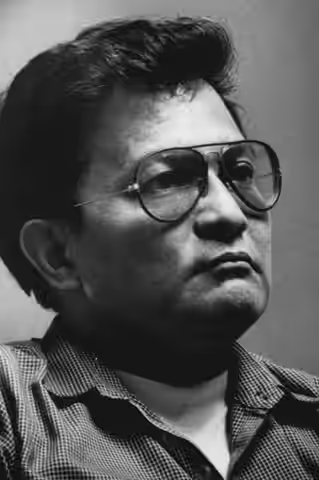
Lino Brocka was a Filipino film director. After working in theatre and television he began directing feature films in 1970, initially making commercial genre pictures.
He gained critical recognition with Manila in the Claws of Light (1975) and Insiang (1976). In 1983 he founded the Concerned Artists of the Philippines, an organisation supporting artists addressing national issues. Brocka directed more than sixty films over two decades and was politically active during the Marcos era.
He died in a car accident in Manila on 22 May 1991.