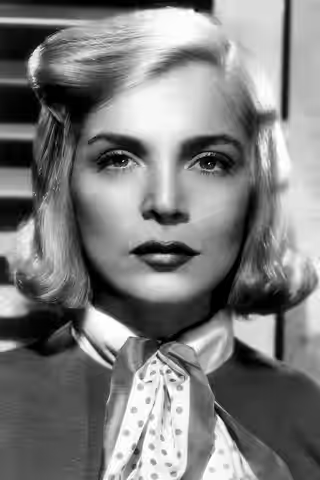
Lizabeth Scott spent a decade in noir being the woman across the desk: a low, worn voice, a face that gives almost nothing away. Some found that mysterious and some found it wooden. On the evidence we have, both were right on different days.
Fi1m perspective
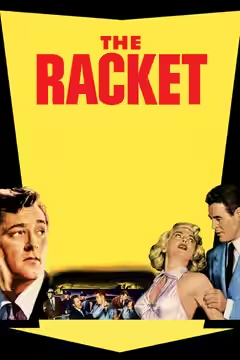
In The Racket (1951) Lizabeth Scott gets one scene that matters, and it is the scene to judge her by. Irene Hayes sits across a precinct-house desk from McQuigg, and for four or five minutes the writing is quick and hard and she meets it line for line in that low, worn voice. She does not lean in. The other person does the moving. Then the film gives her a nightclub number and remembers her only when it needs a witness. We sat up for those four minutes and were sorry when they ended, and the picture around them never quite got us back.
That is the pattern of most of her decade. Hal B. Wallis found her on the stage, signed her to Paramount and put her in You Came Along (1945). The Strange Love of Martha Ivers (1946), with Barbara Stanwyck and Kirk Douglas, got her noticed; Dead Reckoning (1947), opposite Humphrey Bogart, fixed the part she would play for years, the woman whose account of herself cannot be trusted. Pitfall (1948) let her be the vulnerable one for once, and Too Late for Tears (1949) put a scheming, ambitious woman at the centre of the film and let her run it, which is why it is the title most often mentioned first. She made around 22 films by 1957, eight of them for Wallis and two for John Cromwell, The Racket among them. After that she more or less stopped, with a single return in Pulp (1972), a film that pays its respects to the genre she had worked in.
What she had was the voice, husky and worn, which the studios used by making her a nightclub singer whenever they could, and a face, blonde under dark eyebrows, that gave almost nothing away. Contemporary critics did not always take the second as a gift. She was compared to Lauren Bacall from the start, usually to her disadvantage, and in I Walk Alone (1948) and Dark City (1950) she was called wooden. We can see how. The stillness is a choice, but on a flat-lit set it can look like she has simply not been told what to do. It needs a photographer like George E. Diskant, who in The Racket brings faces out of the dark and sends them back, so that a woman doing nothing with her face is what the frame wants. Given that light, she is as good as anyone in the picture. Denied it, she can seem to be waiting for direction.
She said late in life: "I loved making films. There was something about that lens that I adored, and it adored me back." On the evidence of The Racket that is true for about four minutes at a time. Start there, with the interrogation, and then go to Too Late for Tears, where the part is hers and nobody sets her aside.
Biography
Lizabeth Scott was an American actress. Born Emma Matzo on 29 September 1922 in Scranton, Pennsylvania, she trained at the Alvienne School of the Theatre in New York City. She understudied the role of Sabina in the original Broadway production of The Skin of Our Teeth before making her screen debut in the mid-1940s.
Scott appeared in 22 feature films between 1945 and 1972, most of them in the film noir genre. She played leading roles in titles including The Strange Love of Martha Ivers (1946), Dead Reckoning (1947), Pitfall (1948), Too Late for Tears (1949), Dark City (1950) and The Racket (1951) as Irene Hayes. She also worked in stage productions, radio and television. Her final film role was in Pulp (1972). Scott died on 31 January 2015 in Los Angeles.