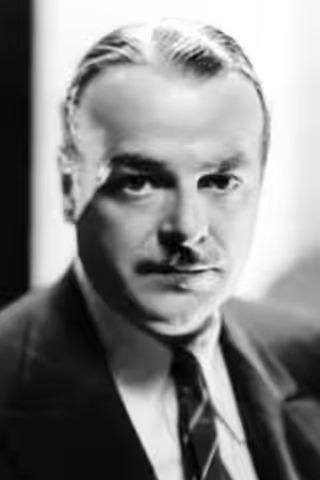
An actor who turned to directing late and briefly, Lowell Sherman knew what a performer needed and got out of the way. His five films are short on style and long on Mae West, Katharine Hepburn and Cary Grant, and that was the right trade.
Fi1m perspective
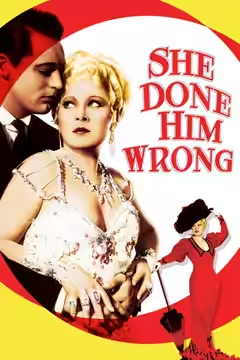
In She Done Him Wrong (1933) the camera is set down where Mae West can walk towards it, and then it is left alone. That is most of what Lowell Sherman does in the film, and it is easy to mistake for nothing. It is not nothing. He had been in front of audiences since childhood and he knew that what a performer of that size needs is room, a clear line to the lens, and a director who does not fidget.
He came to directing late and by way of a long acting career. He made his Broadway debut in 1904 and appeared in silent films from 1914, usually as the smooth villain or the playboy, most notably as Lennox Sanderson in D.W. Griffith's Way Down East (1920). He started directing in 1930 while still taking parts, and his last major role was, fittingly, a film director: Max Carey in George Cukor's What Price Hollywood? (1932). From 1933 he only directed. He once said that "nothing becomes so monotonous as acting on the stage, especially if you are successful", and he found acting in films duller still. Directing, it turned out, was the cure.
His habits were an actor's habits. He liked rehearsal time and he liked to shoot in script order, so that a performance could build in the sequence the audience would see it. Morning Glory (1933) gave Katharine Hepburn a stage-struck part and the space to play it, and it is the film most often held up as proof of what he could get from a cast. Born to Be Bad (1934) put Loretta Young opposite Cary Grant, Sherman's second film with Grant after She Done Him Wrong. Three of his pictures were produced by William LeBaron. Five solo credits, all of them well received by critics and the public at the time, is a small body of work, but not a thin one.
The limits are plain in the film we have reviewed. When West leaves the frame of She Done Him Wrong, the crime story around her turns out to be in pieces, reported from doorways and handled with a shrug, and the shrug is his as much as the writers'. We were startled at how much of it still lands, and honest enough to notice that everything landing was her. Sherman was not a stylist. He was a man who knew where to stand and when to keep quiet.
He died on 28 December 1934, at 46, while preparing Becky Sharp, and he is little known now even among people who watch this period closely. Watch She Done Him Wrong first, for West, and then notice how little gets between you and her. That was the direction.
Biography
Lowell Sherman (11 October 1888 – 28 December 1934) was an American actor and film director. Born in San Francisco, California, he began his career on the stage in 1904 before moving into silent films as an actor in the 1910s and 1920s.
He appeared in films including Way Down East (1920), in which he played Lennox Sanderson, and What Price Hollywood? (1932), as Maximilian 'Max' Carey. In the early 1930s he began directing while still acting, later focusing solely on direction. His notable directing credits include She Done Him Wrong (1933), Morning Glory (1933) and Born to Be Bad (1934). He died of pneumonia in Los Angeles at the age of 46.