Mae West’s 1890s saloon comedy runs 65 minutes and exists to let her walk, sing and look at Cary Grant. The crime plot around her is in bits and nobody, least of all the film, minds. Good, short and still startling.
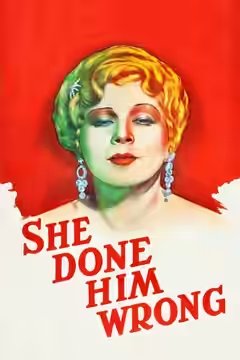
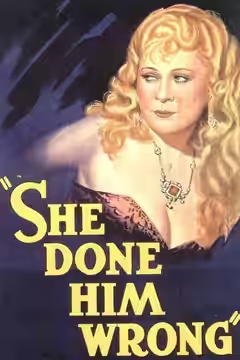
Mae West wrote a play called Diamond Lil and toured it until Hollywood noticed. Paramount bought it, changed the title to something less likely to alarm the censors, and gave her Cary Grant. The result runs 65 minutes and has, on paper, a crime plot: a Bowery saloon in the 1890s, a counterfeiting ring, a jealous man in prison and a mission next door full of hymns. None of it matters. The film is a frame for West, and as a frame it does the job. It is good, it is short, and if you have never seen her you should start here.
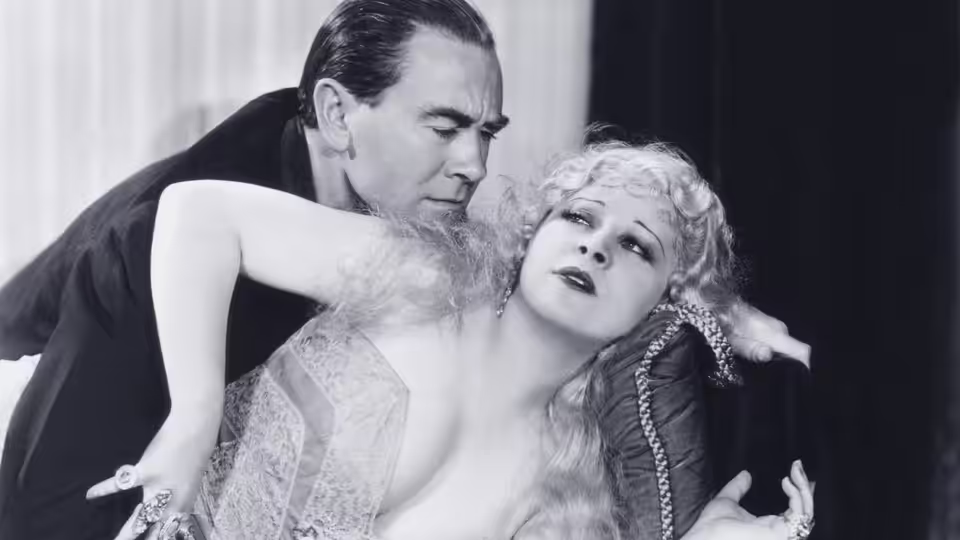
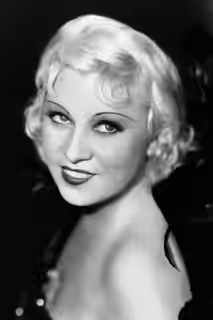
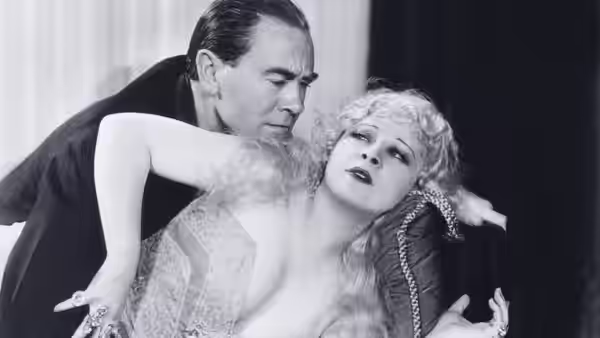
She plays Lady Lou, singer and main attraction at Gus Jordan’s saloon, wearing his diamonds and owing him nothing she can see. What she does, mostly, is walk. West moves as if the floor were slightly too warm, one hand on her hip, and she looks at men the way a buyer looks at a horse. The lines are famous for a reason. When she asks the mission man to come up sometime and see her, delivered over her shoulder on a staircase, we laughed out loud, and we had heard the line a hundred times. It is the pause before it that does it. She lets him, and us, wait.
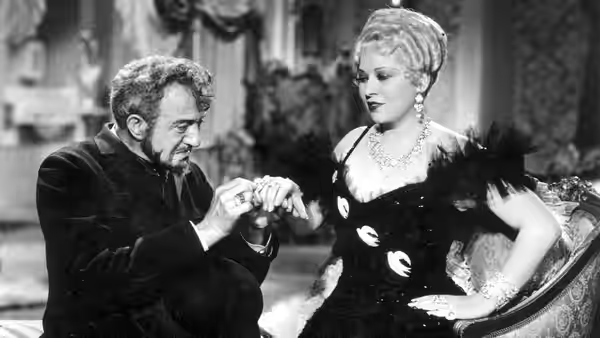
Charles Lang shoots the saloon full of smoke and bodies and gaslight, and he shoots West front-on and softly, so that the light goes to the diamonds and the diamonds do the work. Edith Head’s gowns are the argument of the film: corseted to an hourglass, hung with feathers and stones, built for standing still in, which is what she does in them. John Leipold keeps a saloon band going under everything, and West sings Frankie and Johnny and A Guy What Takes His Time in a voice that is not a singer’s and does not need to be. Alexander Hall cuts fast enough that the plot never has time to be examined, which is a kindness.
Grant plays Captain Cummings, who runs the mission next door and is not impressed by her, or says he is not. He is stiff here, and handsome, and he does almost nothing, which turns out to be exactly what the film needs: someone to be looked at. Noah Beery’s Gus is large and pleased with himself. Gilbert Roland and Rafaela Ottiano, as Serge Stanieff and Russian Rita, arrive with a suitcase of trouble and a great many meaningful glances. Owen Moore glowers from a cell as Chick Clark, the man who went to prison for her. David Landau’s Dan Flynn wants the saloon and wants Lou, in that order or the other.
The flaws are the plot’s. Harvey F. Thew and John Bright’s script has to get a stage act on to the screen, and it leaves the crime story in pieces: things happen in doorways, or offstage, and are reported afterwards. Every scene without West sags, and there are more of them than you remember. Rochelle Hudson’s Sally, a girl Lou pulls back from a bad end in the first ten minutes, exists to be rescued and then to be forgotten. The business Gus is running with his new friends is nastier than the film ever admits, and its shrug at that is the one place where the period shows in a way that is not charming. Lowell Sherman’s direction is mostly a matter of knowing where to stand the camera so that she can walk towards it. The second half takes a turn we will not describe, and it is handled with the same shrug.
The year after this, Hollywood began enforcing its Production Code in earnest, and films like this one are the usual explanation. What is striking, watching it now, is not the smut, of which there is little you could point to. It is that here is a woman who does exactly as she likes for 65 minutes and is not made to pay for it. We found that more startling than any of the jokes. Most later films about women like Lou end with a lesson. This one does not.
Watch it with someone who thinks old films are slow. It is over before they can finish saying so.