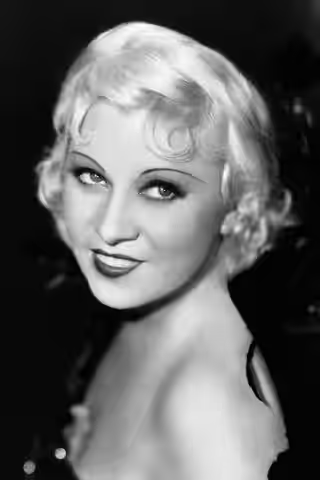
Mae West wrote her own lines and walked across rooms as if she owned them. For a few years in the 1930s nobody on screen was funnier about wanting things, and the censors made sure it did not last.
Fi1m perspective
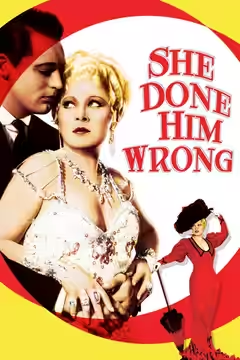
Watch what Mae West does with a staircase. In She Done Him Wrong (1933) she takes one with a hand on her hip, moving as if the floor were slightly too warm, and looks back over her shoulder at the mission man the way a buyer looks at a horse. Then she asks him to come up sometime and see her. We laughed out loud, and we had heard the line a hundred times; what did it was the pause before it, which she stretches until he, and we, have started to wait. That is the whole act. The words are hers, the walk is hers, and the timing is the one thing nobody else could have written down.
She had been doing it for thirty years before a camera saw it. West was in vaudeville as a child from around 1901 and on Broadway from 1911, and from 1926 she wrote, produced and starred in her own plays. Hollywood took her in 1932, in a supporting part, Maudie Triplett in Night After Night, and one line told everyone what had arrived: "Goodness had nothing to do with it." Paramount then bought her play Diamond Lil, renamed it She Done Him Wrong, gave her Cary Grant, and let her write I'm No Angel (1933) as well, with Grant again. She wrote or adapted most of what she said on screen, which is why every line sounds like her.
Most of what works in her films is her. Lowell Sherman's direction on She Done Him Wrong is largely a matter of putting the camera where she can walk towards it. Charles Lang lights her front-on and softly so the light goes to the diamonds; Edith Head builds gowns to be stood still in, which is what she does in them. She sings Frankie and Johnny in a voice that is not a singer's and does not need to be, a nasal contralto that makes a plain sentence sound like a proposition. The crime plot is left in pieces and every scene without her sags. She played one woman, sexually confident, of doubtful virtue and cheerful about it, and she played her every time.
It did not last, and that was not her fault. From the mid-1930s the censors took the double meanings out, and Klondike Annie (1936) is where the damage is usually dated. My Little Chickadee (1940) gave her W.C. Fields for a partner and is the later film worth knowing about. Then a long absence, filled with stage, nightclub and recording work, and a return in Myra Breckinridge (1970) as Leticia Van Allen, which was received as camp and which we will leave to the brave. Start with She Done Him Wrong. It runs 65 minutes, most of them spent letting her look at Cary Grant, and that turns out to be plenty.
Biography
Mae West, also credited as Mary Jane West, was an American actress, playwright and screenwriter. Born in Bushwick, Brooklyn, she began performing in vaudeville as a child and appeared on Broadway from 1911. She wrote, produced and starred in her own plays, including Sex (1926) and Diamond Lil (1928).
West moved to Hollywood in the early 1930s. She starred as Lady Lou and contributed to the screenplay of She Done Him Wrong (1933), and played Tira in I'm No Angel (1933). Later credits include Myra Breckinridge (1970). She also appeared on television, including Mister Ed (1961), and continued stage and nightclub work into later decades.