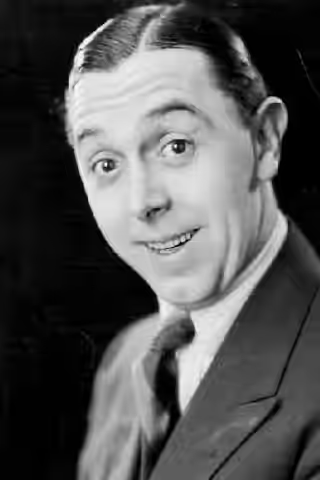
A music-hall acrobat who fell over for a living, Lupino Lane spent his Hollywood years in two-reel shorts and one valet's part for Lubitsch, then went home to the stage, where his name was actually made.
Fi1m perspective
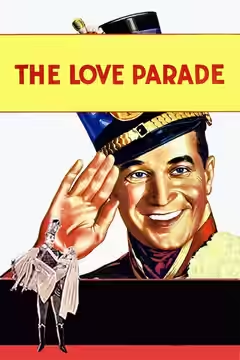
In The Love Parade (1929) the count sings Paris, Stay the Same to the city from a window, and his valet Jacques takes the second verse for the maids down below. That is Lupino Lane's place in the film, and he knows it. When he and Lillian Roth get Let's Be Common in the pantry, he does not sing the number so much as fall through it, and the falls are the performance. He was double-jointed and he had been flipping and dropping in front of paying audiences since 1896, when he went on as a child called Little Nipper, and the body on screen has that history in it. Nothing looks dangerous and everything looks impossible.
He had been in British silent shorts from 1915 and in Hollywood from the early 1920s, and from 1925 to 1929 he made a run of acrobatic two-reel comedies for Educational Pictures, often directing them himself under the name Henry W. George, with his brother Wallace Lupino alongside him and Jack White producing. Sword Points (1928) sends up The Three Musketeers; Only Me (1929) has him playing twenty-seven parts. These were programme fillers, shown before the main feature and forgotten by most of the audience on the way home, and we have not reviewed them, so we will not pretend to judge them. What they built was a technique, and Lubitsch bought it.
Lane told a columnist in 1929 that he had wanted to get out of what he called the two-reel racket for three years, and The Love Parade is what getting out looked like: a supporting part in a big talkie, which is a promotion and a demotion at once. Merrill G. White's cutting keeps sending the film from palace to pantry, so that every grand feeling upstairs gets a cheap echo below, and Lane is the echo. We laughed harder at Let's Be Common than at anything happening upstairs, and the reason is simple: everyone else in the film is acting funny, and Lane is doing something that is funny, with his knees and his spine, and the difference shows on camera. Then, in 1930, he went back to Britain.
The rest of the career is a stage career, and the biggest thing in it is Me and My Girl, which he starred in, directed and produced from 1937 to 1940, playing the cockney Bill Snibson and sending The Lambeth Walk out into the world. That is why he is remembered, when he is remembered, as a theatre man rather than a film one, and why the Hollywood decade sits oddly in his story, a long apprenticeship for a career that happened somewhere else. The camera got a few years of a good acrobat and one valet who stood out.
If you want to see what a music-hall body could do when a real director pointed a camera at it, watch The Love Parade and keep your eye on the pantry. The film has bigger names upstairs. The man downstairs is the one who never needed the song.
Biography
Lupino Lane, born Henry William George Lupino, was an English actor and theatre manager. A member of the theatrical Lupino family, he began performing as a child under the name 'Little Nipper' and appeared in music hall and stage productions from an early age.
He made numerous silent comedy shorts in Hollywood during the 1920s, showcasing his acrobatic skills, and played the supporting role of Jacques in the Ernst Lubitsch musical The Love Parade (1929). Lane later returned to Britain, where he achieved his greatest stage success as Bill Snibson in the long-running musical Me and My Girl (1937), which popularised the 'Lambeth Walk'.
His brothers were actors Wallace Lupino and Stanley Lupino; his cousin was actress and director Ida Lupino. He was married to actress Violet Blythe from 1917 until his death in 1959.