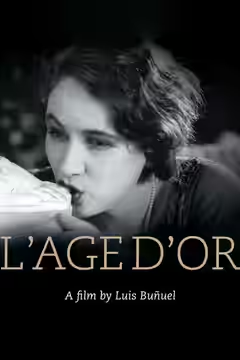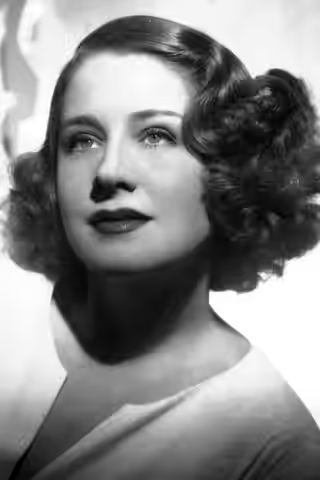
Lya Lys gives the frustrated desire of L'Âge d'or a force the film needs, though its nameless lovers allow little warmth. We value her intensity there; Hollywood's smaller parts made more conventional use of her.
Fi1m perspective
In L'Âge d'or (1930), Lya Lys is The Woman, opposite Gaston Modot's The Man. Neither has a personal name, and that tells us something about the acting Luis Buñuel needs from them. Their thwarted desire matters more to him than the ordinary details that might make them a recognisable couple. Lys gives that desire intensity, but the anonymity also limits how close we can feel to her. We recommend the film for its sly humour and abrasive treatment of sexual morality, with reservations about the more laboured provocations.
There is an awkward demand on Lys here: she must make the woman's passion felt while playing someone identified chiefly by her place in a couple. Her intensity suits the task, and helps explain why this remains her best-known work. We were less moved by the romance than we wanted to be, because the pair's anonymity kept us at a distance. It would be unfair to treat that distance as a failure of the actress alone.
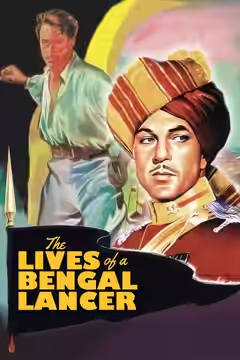
Hollywood more often cast her as alluring or vampish Continental women, a narrower demand than the central role Buñuel had given her. MGM had brought her over for French-language versions, but her accent restricted her early English-language parts. The uncredited Girl on Train in The Lives of a Bengal Lancer (1935) gives some idea of how small those opportunities could be. Later parts included Erika Wolf in Anatole Litvak's Confessions of a Nazi Spy (1939) and Angela Merrova in The Return of Doctor X (1939), the latter alongside Humphrey Bogart.
Her final screen role was Hilda Riker in Murder in the Air (1940), opposite Ronald Reagan. We would start with the earlier Buñuel film, where she has a central part rather than one of Hollywood's smaller assignments. Go for the sly jokes, and do not expect the romance to soften them.
Biography
Lya Lys was a German-born American actress. Born Nathalie Margoulis in Berlin on 18 May 1908, she moved to Paris as a child and was educated in France and Switzerland. She later studied languages at the Sorbonne.
Lys began her film career in the late 1920s and appeared in French-language versions of Hollywood productions. Her most notable early role was as The Woman in Luis Buñuel and Salvador Dalí's L'Âge d'or (1930). She later worked in Hollywood, with credits including an uncredited part in The Lives of a Bengal Lancer (1935) and a role in The Return of Doctor X (1939). She became a US citizen in 1933 and was active in film until 1940.