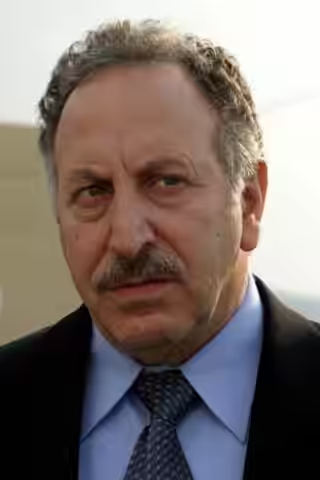
Makram Khoury is the man at the head of the table in other people's stories: the father, the minister, the sheikh, played with a stillness learned on stage and a refusal to judge anyone. He is nearly always worth more than the scene gives him.
Fi1m perspective
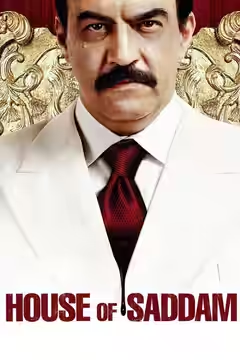
Watch Makram Khoury in House of Saddam (2008) during the dinners and the councils, when the camera is on Yigal Naor and the room is waiting to find out what mood he is in. Khoury's Tariq Aziz is the courtier who knows the exact weight of each silence, and the performance is almost entirely in what he does not do: he does not lean in, he does not look away, he lets a pause run a beat longer than anyone else at the table would dare. We found ourselves watching him in scenes that were about somebody else, which is the surest sign a supporting actor is doing his job.
That stillness was learned on stage. Khoury spent twenty years with the Haifa Municipal Theater and worked at the Cameri in Tel Aviv, and the screen career that grew out of it from the mid-1990s has the marks of a text actor: measured, unhurried, more interested in what a line means than in how it can be decorated. He has said "I never judge my characters," and you can see it. His officials and patriarchs are men with reasons, not positions in an argument.
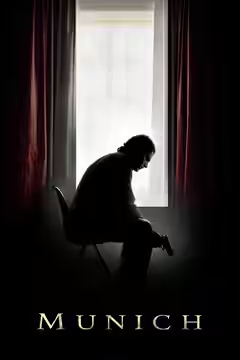
The parts that made his name abroad came with Eran Riklis, as the Druze father Hammed in The Syrian Bride (2004) and as Abu Kamal in Lemon Tree (2008), both ensemble pieces about people living on a border, and with Amos Gitai in Free Zone (2005). Hiam Abbass has been opposite him six times. Then the English-language work: Wael Zwaiter in Munich (2005), Aziz for the BBC and HBO, Samir Khalil in Homeland (2015), the blind Sheikh Negm in Cairo Conspiracy (2022), and The Master and Margarita (2024). Between films he has gone back to the theatre, to Peter Brook's 11 and 12 and to Shylock for the RSC in 2015.
The pattern is plain and so is its cost. Khoury is nearly always the elder who speaks for a household or a community, and the films have not always been as good as he is in them. Nobody has had a bad word to say about the performances; the same cannot be said of every title, and Unlocked (2017) is not the only one where he is the most interesting thing in a picture few people liked. Magic Men (2013), a lead in a domestic Israeli comedy-drama, shows what happens when a script lets him carry it rather than steady it.
He works in Hebrew, Arabic and English and has played both sides of the divides those languages mark, and he does it without changing his manner. If you want to see what he can do, start with The Syrian Bride. If you want to see how little he needs, watch him listen to Saddam.
Biography
Makram J. Khoury is a Palestinian-Arab actor. He was born on 30 May 1945 in Jerusalem in the British Mandate of Palestine. He studied at the Mountview Academy of Theatre Arts in London from 1970 to 1973 and has been a long-standing member of the Haifa Municipal Theater.
Khoury won the Israel Prize for theatre in 1987, becoming the youngest recipient and the first Arab to receive the award. His screen credits include Munich (2005), The Body (2001), Homeland (2011) and House of Saddam (2008), in which he played Tariq Aziz. He has also appeared in The West Wing (2004), The Physician (2013), Unlocked (2017), Messiah (2020) and Cairo Conspiracy (2022).
His children Clara Khoury and Jameel Khoury are also actors.