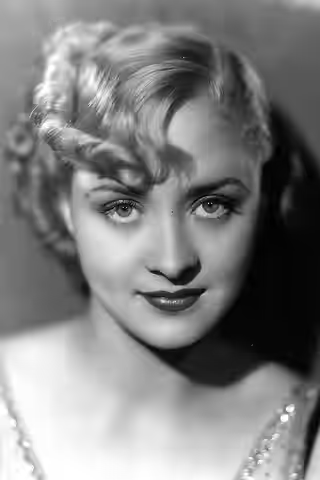
A pre-Code ingénue whose job was to be menaced by Barrymore, Karloff and Lorre, and who did it with real sincerity and the stage technique of the day. In the one film of hers we have reviewed, the two pull against each other.
Fi1m perspective
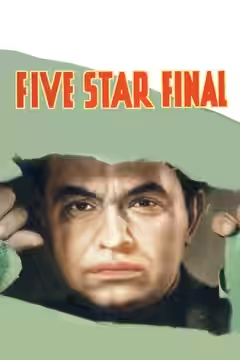
The part Marian Marsh played, over and over, was the girl in the frame with the dangerous man. John Barrymore chose her for Svengali (1931), and the rest of the decade followed the pattern: Boris Karloff in The Black Room (1935), Peter Lorre in Crime and Punishment (1935), Edward G. Robinson at the newsdesk in Five Star Final (1931). She was small, blonde and doll-faced, and the studios read that as innocence. The films needed someone worth threatening, and she looked it.
The career was short at the top. She began in shorts and bit parts as Marilyn Morgan, selling kisses in Hell's Angels (1930), and became a Warner Bros. leading lady with Svengali. By the end of 1932 she had left the studio; there were two years in Europe, a Columbia contract from 1935 to 1937, then B pictures until House of Errors (1942) and a few television appearances in the 1950s. The usual explanation is typecasting, and we see no reason to argue with it. A studio that has found a face to menace has little reason to find out what else it can do.
Five Star Final is the film of hers we know best, and it is not kind to her. Mervyn LeRoy's attack on the scandal press is still angry, and Robinson and Karloff are both excellent in it. Marsh plays Jenny Townsend, daughter of the family the paper decides to ruin, and her parents, H. B. Warner and Frances Starr, act in the register of the parlour drama: enter, announce the feeling, stand still. The second half takes a turn we will not describe, and Marsh plays what follows pitched at the back row of a theatre. We believed her distress and still found ourselves wishing LeRoy had cut away twenty seconds sooner; the tears run longer than the point needs, and the biggest scene she is given is the stretch of the film that has dated most.
That is one performance in one film, and the people who wrote about her over the years were warmer than we have been. Warmth and sincerity are the words that recur, and Sonya in Crime and Punishment, opposite Lorre, is the part most often cited; we have not reviewed it and will not judge it from a distance. What we can say is that the sincerity in Five Star Final is real, and that the technique around it belongs to 1931. Watch that film for Robinson and Karloff, and watch her in the corner of it to see what the pre-Code studios asked of a leading lady, and how quickly they stopped asking.
Biography
Marian Marsh was an American actress. Born Violet Ethelred Krauth on 17 October 1913 in Trinidad, British West Indies, she began her career in the late 1920s under the name Marilyn Morgan before signing with Warner Bros. and adopting the name Marian Marsh.
She appeared in Hell's Angels (1930) and gained leading roles in the early 1930s, including Jenny Townsend in Five Star Final (1931), Trilby O'Farrell in Svengali (1931), Thea Hassel in The Black Room (1935) and Sonya in Crime and Punishment (1935). Her film work continued into the early 1940s. She was later an environmentalist and founded the conservation group Desert Beautiful in California.