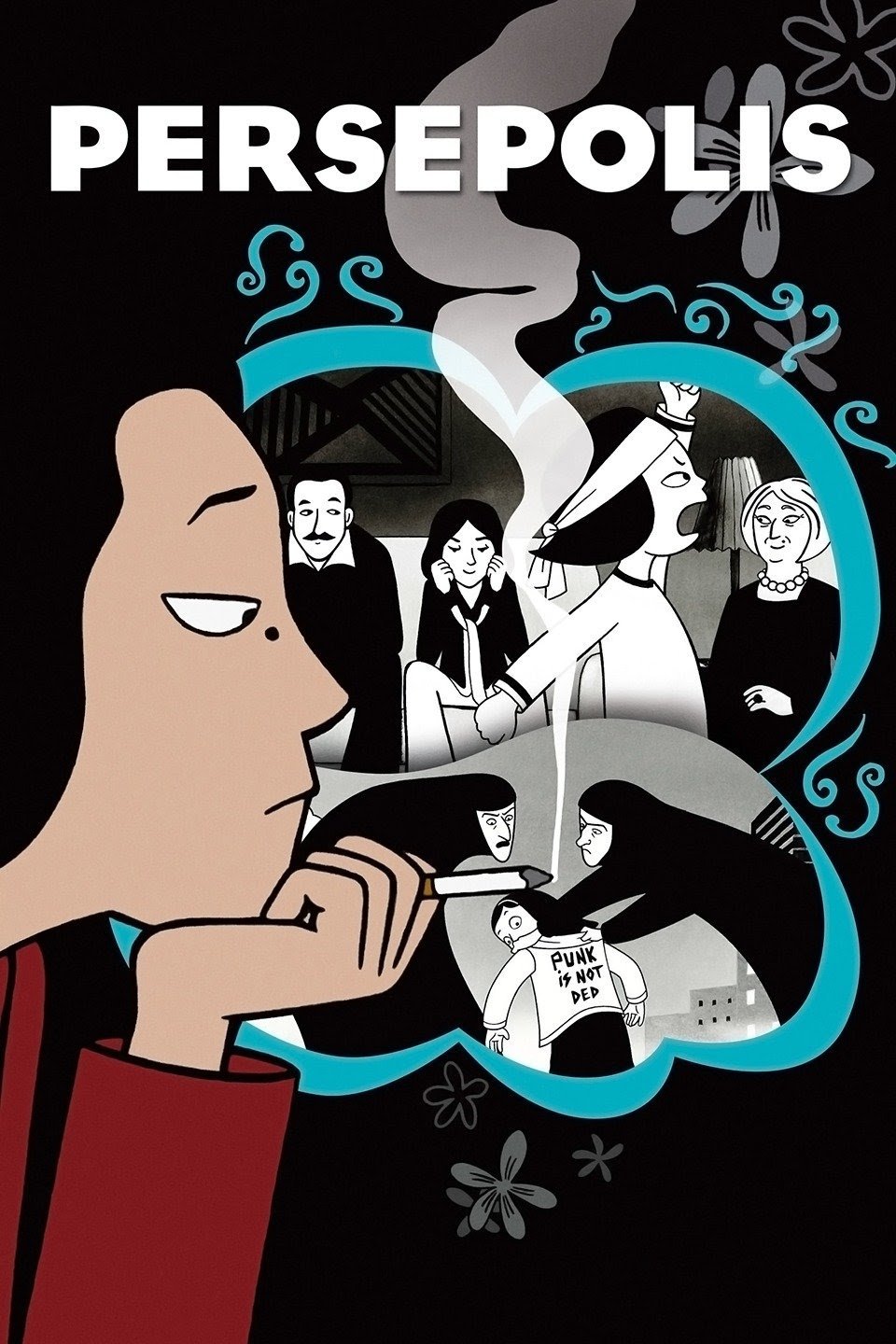
Marjane Satrapi’s strongest filmmaking lets people be awkward, funny and wrong without making them impossible to care about. We recommend Persepolis warmly for that generosity, with a reservation about how often its brisk storytelling moves on too soon.
Fi1m perspective
In Persepolis (2007), a face drawn with only a few lines can make a young girl’s lack of proportion understandable. Satrapi and Vincent Paronnaud let Marjane take her own troubles seriously, even when there is greater suffering around her. They also allow us to see when she is being unreasonable. We laughed at her youthful self-importance because the film refuses to treat every embarrassment as proof that she is destined for something remarkable. That willingness to risk our disapproval makes her feel like someone whose company we have actually kept.
Satrapi began in features by adapting her own graphic memoirs with Paronnaud. They moved into live action together with Chicken with Plums (2011), another graphic-novel adaptation. The Voices (2014), an English-language dark comedy, then made a deliberate break from Iranian subjects. The Marie Curie biopic Radioactive (2019) moved further from her autobiographical beginnings. The later work could be uneven in tone, while Radioactive too often settled for familiar biopic habits; choosing a different kind of film did not always bring out her strengths.
The family scenes in Persepolis explain why that first collaboration remains the place to start. Satrapi and Paronnaud use the child’s incomplete understanding to make large events comprehensible, giving us people to care about before asking us to absorb their circumstances. The bold black-and-white animation retains the lines of her comics without leaving the faces stiff or remote. A few strokes are enough to make Marjane’s contradictions readable, and the humour allows us to feel affection for her without excusing everything she does.
The cost is haste. Some episodes in Persepolis end just as we want to spend longer with them, and the wider history can feel squeezed between the personal incidents. Satrapi and Paronnaud’s instinct for what a drawing can tell us is surer than their judgement of how long a passage needs. We would happily lose some incident to give those relationships more time. Start with Persepolis, especially if you prefer a coming-of-age story whose heroine can be a nuisance.
Biography
Marjane Satrapi is a French-Iranian director, writer and graphic novelist. She co-directed and co-wrote the animated film Persepolis (2007) with Vincent Paronnaud, adapting her own autobiographical graphic novel of the same name.
Her other directorial credits include the live-action films Chicken with Plums (2011), also co-directed with Paronnaud and adapted from her graphic novel, The Voices (2014) and Radioactive (2020). She studied art in Strasbourg after earlier time in Vienna and Tehran.
Satrapi died in Paris in June 2026.