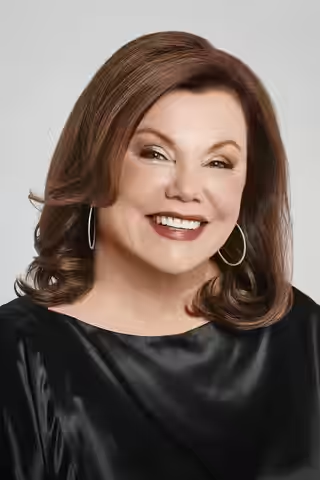
Marsha Mason plays women who have been left and are furious about it, and her best moments are the ones where the fury lapses. Neil Simon gave her the parts and, too often, the volume; she is better than the scripts let her be.
Fi1m perspective
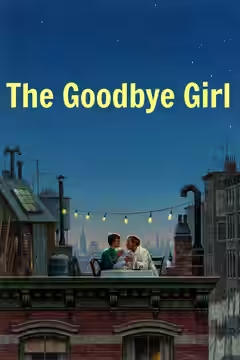
There is a moment in The Goodbye Girl (1977) where Paula McFadden stands in a doorway, her lodger says something kind, and she has no answer ready. For an hour Mason has been playing rudeness, because that is what Neil Simon wrote for a woman left by two men, the second while she was out. Then the face goes still and something younger looks out of it. That is what Mason does. She plays the defence loudly and the crack quietly, and the crack is where she earns her keep.
The career divides in two. Before Simon there was the stage, daytime soaps, a low-budget debut in 1966, and then Maggie Paul in Cinderella Liberty (1973), a pool-hustling prostitute opposite James Caan, the part that made her a leading film actress. Then came Simon, five films together between 1977 and 1983, among them Chapter Two (1979), Only When I Laugh (1981) and Max Dugan Returns (1983). The women are variations on one woman: urban, resilient, single or lately divorced, coping with a setback she did not choose. After 1983 the film work slowed. Heartbreak Ridge (1986), as Aggie opposite Clint Eastwood, kept her on screen; after that it was recurring television, in Frasier, The Middle and Grace and Frankie, and the theatre, where she has directed since the mid-1980s and is still working in the 2020s.
What she is good at is not seeming to act. She plays a scene as if she has not read the next page, and she is at her best when the character is caught out: at an audition she is too old for, in that doorway. She works for it, too. She had never danced before The Goodbye Girl and for three months "ran to dance classes all over Los Angeles" for two scenes. Richard Dreyfuss brings out the best in her, because he is fast and she is not, and the film needs someone in the flat who takes a beat.
The trouble is the defensiveness, and it is only partly hers. Some critics found Paula exhausting, and the same note has followed her in lighter parts. For most of the first hour of The Goodbye Girl we were on the lodger's side and slightly ashamed of it, because Mason was plainly working and Simon had handed her the volume while Dreyfuss got the jokes. Then the audition scene arrived and she had us. Simon wrote her fast and mistook fast for funny; the actress underneath is slower and truer than the lines.
Start with The Goodbye Girl, and watch the quiet scenes. The loud ones are Simon's.
Biography
Marsha Mason is an American actress and theatre director. Born on 3 April 1942 in St. Louis, Missouri, she made her film debut in 1966 and rose to prominence in the 1970s.
She received Academy Award nominations for Best Actress for her performances in Cinderella Liberty (1973), The Goodbye Girl (1977), Chapter Two (1979) and Only When I Laugh (1981). The first two films also earned her Golden Globe Awards. She appeared in several films written by playwright Neil Simon, to whom she was married from 1973 to 1983, including The Goodbye Girl in which she played Paula McFadden. Mason has also worked extensively in television, with recurring roles in series such as Frasier and The Middle.