Neil Simon’s romantic comedy runs on wisecracks, and Richard Dreyfuss makes them sound like a man thinking. Marsha Mason is handed a harder job and a colder character. Worth an evening for him, for the flat, and for one disastrous first night.
Neil Simon’s script puts two people who cannot stand each other into one small New York flat and waits for them to fall in love, and Herbert Ross films it much as he would have staged it: in rooms, with the door shut. That is the whole ambition, and there is nothing wrong with it. The Goodbye Girl is a good evening if you can take 111 minutes of people answering back, and Richard Dreyfuss makes the case for it almost on his own.
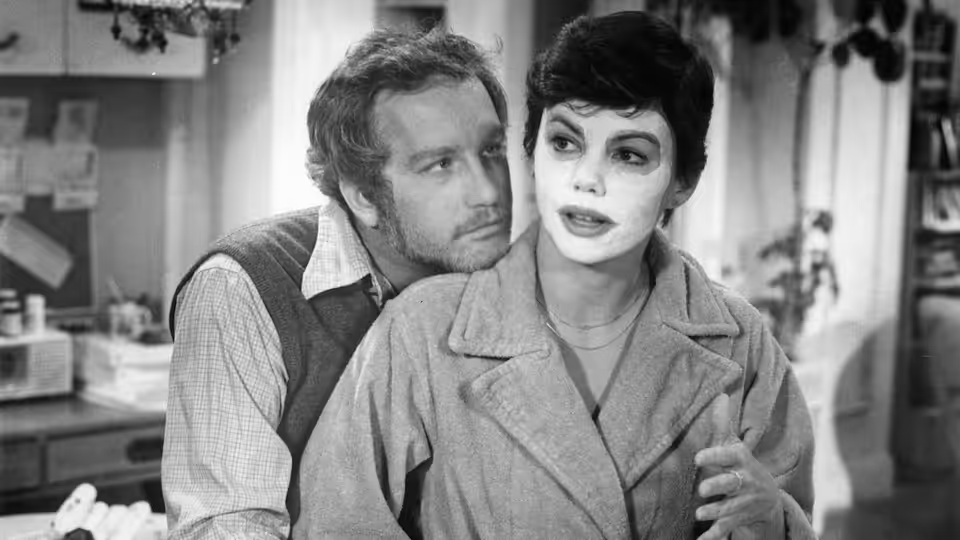
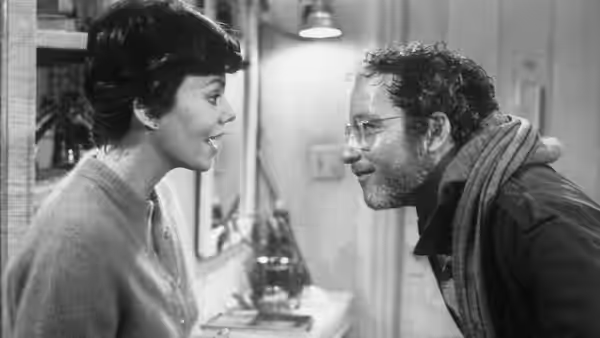
Elliot Garfield (Dreyfuss) arrives soaked, with a key and a signed sublet, and finds Paula McFadden (Marsha Mason) and her daughter Lucy McFadden (Quinn Cummings) still in residence, because the man who sublet it never told them. Dreyfuss plays Elliot as an actor who knows he is one. He declaims, he sulks, he plays the guitar in the small hours. What makes it more than a turn is how fast he drops it when the child is there. He talks to her as if she were a colleague, and the film’s warmest scenes are the ones where the two of them agree, quietly, that her mother is impossible.
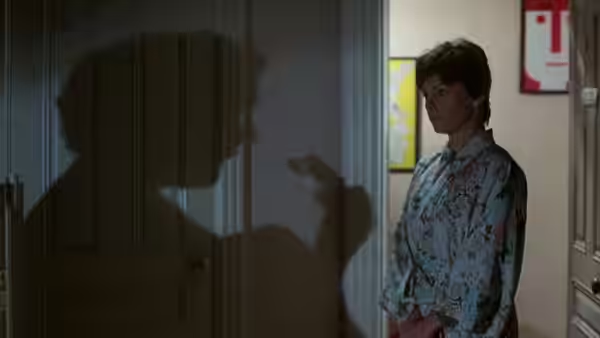
Mason has the harder job. Paula has been left by two men, the second while she was out, and Simon writes her defence as rudeness, an hour of it, before he lets her be anything else. Mason is good at the anger and better in the moments it slips: at an audition she is too old for, in a doorway when Elliot says something kind and she has no answer ready. But the script gives Elliot the jokes and Paula the volume, and for a long stretch we were on the lodger’s side and not sure the film wanted us there. Some critics at the time found her exhausting. We would not go that far. Simon has written her fast and mistaken fast for funny.
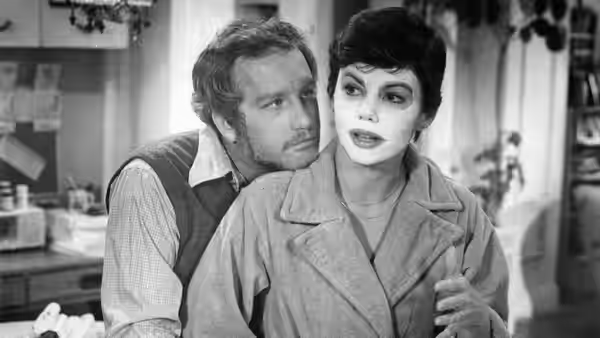
The subplot is where the film is best. Elliot has come to New York to play Richard III off Broadway for a director, Mark (Paul Benedict), who has decided the king should be a shrieking caricature of a homosexual. Elliot argues, loses, and does it. The rehearsals are funny in the ordinary Simon way. The first night is something else. We laughed a great deal, then Ross cut to Dreyfuss’s face while the audience laughed at him, and we stopped and felt for the man, slightly ashamed of ourselves. It is the one sequence where the comedy and the pain are on screen at the same moment. The joke leans on an idea of gay men that was cheap in 1977 and has not improved; the film knows Mark’s idea is a bad one but collects the laughs on the way to saying so.
David M. Walsh shoots the flat in brown lamplight and the opening in rain, so that Elliot arrives on the worst night of his year. Albert Brenner’s flat is the real third lead: too small, one bathroom, a kitchen you pass through to reach anything, a bedroom door that matters. Ann Roth keeps Paula in leotards and leg warmers, a dancer who has not stopped dressing as one, and gives Elliot the shirts of a man who thinks he is bohemian. Dave Grusin’s score is light and jazzy and stays out of the way. John F. Burnett cuts in long two-shots and lets the lines volley, which is what Simon needs.
Once they stop fighting, the film has little left to do, and the last half hour shows it. Simon produces a job offer to put at risk what he has spent an hour building, and the scenes that follow are pleasant and slack. Cummings speaks Simon’s lines like a small adult, which some will find hard to bear; we found she underplays them enough to get away with it, and she is never asked to be cute.
Critics have never agreed about this one; the argument is about Simon. We are nearer the admirers without joining them. See it for Dreyfuss, for the flat, and for that first night. Bring a tolerance for people who answer a question with another question.