Herbert Ross was a choreographer who directed films as if he were staging them: the actors get the stage and the camera keeps its seat. It makes him generous to performers and a plain, sometimes flat, director of everything else, dancing included.
Fi1m perspective
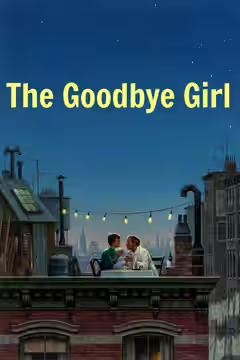
In The Goodbye Girl (1977) Richard Dreyfuss plays the first night of a Richard III he knows is wrong, and while the audience laughs at him, Ross holds on his face. It is the best moment in the film and it tells you what Ross is for. He puts good actors in a small room, keeps the door shut and waits for something to happen between them. When it does, he knows to stay on it.
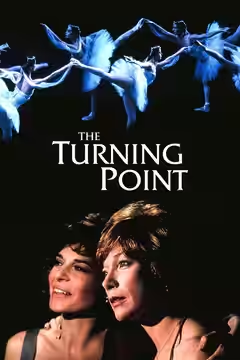
He came to films from ballet and Broadway, where he had been a dancer and then a choreographer through the 1950s, and he directed his first feature, Goodbye, Mr. Chips, in 1969. The peak came in 1977, when The Turning Point and The Goodbye Girl arrived in the same year: the first a ballet drama he made with the producer Nora Kaye, the second one of five Neil Simon adaptations he would direct, a run that began with The Sunshine Boys (1975). He worked repeatedly with the producer Ray Stark and three times with Barbra Streisand. Later came Footloose (1984) and Steel Magnolias (1989), and he kept working into the mid-1990s.
What works is the actors, and particularly the women. Anne Bancroft and Shirley MacLaine get two proper parts in The Turning Point, and the film is at its best when the pair of them are arguing about the lives they chose. Ross put it down to his years in ballet: "I spent all those years in ballet, and as Balanchine said, ballet is woman. I'm used to perceiving women as independent and often more than our equals." Marsha Mason in The Goodbye Girl is handed a colder character and a harder job, and the film does not quite rescue her. Dreyfuss, though, makes Simon's wisecracks sound like a man thinking, which is rarer than it sounds.
What does not work is the camera. In The Turning Point, Robert L. Surtees shoots the ballets front on from the stalls and William H. Reynolds cuts inside the variations, so a jump begins in one shot and lands in another. A choreographer of all people should know that a dance has a shape, and Ross gives us a well-lit record instead. We came away from that film irritated, and a little sad, because the man who made it knew better than anyone in the building what we were missing. The same habit runs through the Simon films: rooms, doors, people answering back, and a director content to let the writing do the work. When he tried something more stylised, in Pennies from Heaven (1981), audiences were puzzled, and critics were not sure what to make of it either.
Start with the two 1977 films and watch them for the faces. The dancing you will have to imagine. The dancers, tired and cross and coming off stage, he gets right.
Biography
Herbert Ross (1927–2001) was an American director, producer, choreographer and actor who worked in theatre and film. He began as a dancer and choreographer, with early credits including Broadway productions and uncredited work on the film Carmen Jones (1954). He later choreographed for films including Funny Girl (1968).
Ross made his feature directorial debut with Goodbye, Mr. Chips (1969). He directed and produced The Turning Point (1977) and directed The Goodbye Girl (1977). He collaborated frequently with playwright Neil Simon on screen adaptations including The Sunshine Boys (1975), California Suite (1978) and others. Later films include Footloose (1984) and Steel Magnolias (1989).
For The Turning Point, Ross received Academy Award nominations for Best Director and Best Picture (as producer), and won the Golden Globe for Best Director.