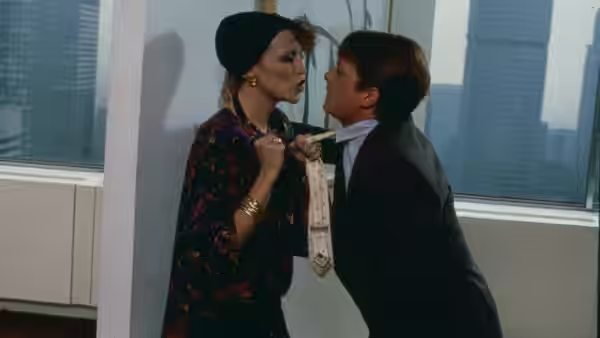
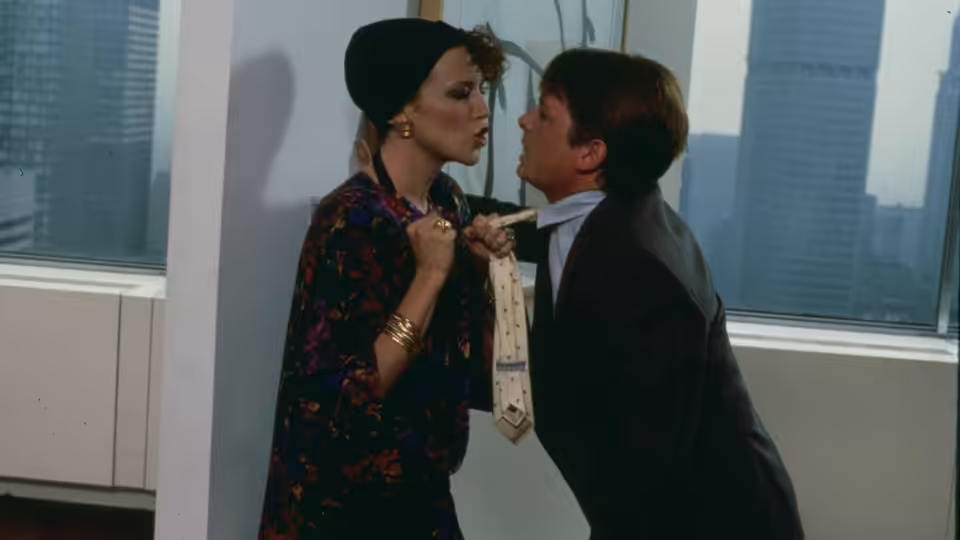
Brantley Foster (Michael J. Fox) leans toward Vera Prescott as she grips his tie in an office
Film review

The Secret of My Success

1987 · Directed by Herbert Ross · 1h 51m · MPA PG-13

In a sentenceThe leading man deserves a pay rise for doing so much of the screenplay’s work

In Manhattan, Brantley Foster (Michael J. Fox) wants to get beyond the post room and into the corporate ranks. He also goes by Carlton Whitfield, giving his bid for success the complication of a second identity. His ambitions bring him into the company of Christy Wills (Helen Slater), Howard Prescott (Richard Jordan) and Vera Prescott (Margaret Whitton). Business and personal appetites become tangled as Brantley tries to get ahead. Between the office comedy and the bedroom farce, he has to manage two versions of himself while pursuing the career he wants.

Fi1m review

Michael J. Fox makes this corporate wish fulfilment pleasant company, but the jokes seldom match his energy. Herbert Ross offers enough polish for a light evening, provided the lead matters more than the laughs.

Herbert Ross’s The Secret of My Success is a passable corporate comedy carried by an unusually persuasive star. Its fantasy of advancement asks us to enjoy Brantley Foster’s nerve without looking too closely at what makes him qualified to succeed. That is a workable invitation for a farce, and Michael J. Fox does his considerable best to honour it. Too often, though, the jokes depend on his delivery to make them worth hearing.

Brantley’s other identity, Carlton Whitfield, gives the performance a useful supply of strain, even when the script is short of surprises. Michael J. Fox makes the ambition seem eager rather than calculating, which matters when the wish fulfilment is this shameless. We found ourselves rooting for him because his assurance never seems entirely settled; there is effort beneath the optimism. He makes us want the next opportunity to work out, even when we have little interest in the business surrounding it.

Helen Slater’s Christy Wills needs more comic room than the film allows her, and the supporting parts generally suffer from the attention lavished on Brantley. Richard Jordan gives Howard Prescott the necessary weight, though the corporate comedy offers him little that might complicate its familiar attitudes to authority. Margaret Whitton is livelier as Vera Prescott, bringing an appetite for the farce that the direction does not always share. These are performers doing useful work within narrow parts.

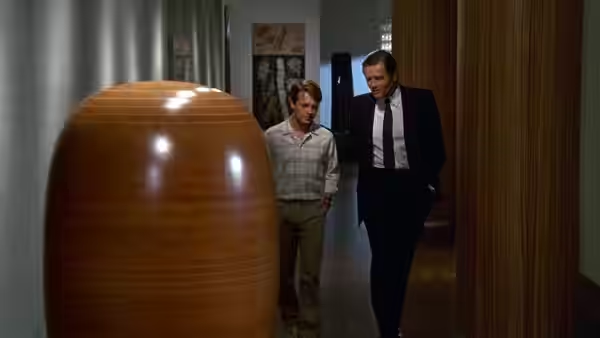
Carlo Di Palma photographs Manhattan with an inviting polish, giving the fantasy somewhere worth wanting to be. Edward Pisoni and Peter S. Larkin’s production design makes the corporate surroundings suitably desirable, helping to explain why Brantley is so keen to belong. The film plainly enjoys the prospect of success, and its visual finish does more to explain that attraction than the dialogue does. That glossy look is appropriate, although there are stretches when the setting is more engaging than the conversation.

Paul Hirsch’s editing keeps the corporate material moving briskly, but the bedroom farce is heavier going. The changes of comic pace expose how little Herbert Ross has found to connect the two. David Foster and Boris Blank’s music supplies welcome energy, and the soundtrack can put us in a better mood than the writing deserves. Yet brisk cutting and cheerful accompaniment cannot make a strained situation funny on their own.

The screenplay by Jack Epps Jr. and Jim Cash, with a writing credit for AJ Carothers, needs sharper jokes and more exact timing. A workplace farce can survive unlikely advancement and mistaken impressions; much of the pleasure comes from watching people struggle to maintain them. Here, the shifts between corporate ambition and sexual complication too often feel awkward. The film happily indulges the dream of getting ahead, but has little curiosity about what success might cost or whom it might exclude. We do not need a lecture on business ethics, though more resistance to Brantley’s wishes would have made the comedy less comfortable.

At 111 minutes, there is more of this than the premise can comfortably support. The charm remains, but it has to cover too many stretches in which the comedy merely goes through the motions. Admirers of Michael J. Fox’s eager, resilient screen presence will find enough to enjoy. Come for a light star vehicle, and allow for the jokes he cannot rescue.

Critical consensus AI synthesised

61
Positive
2
Mixed
3
Negative
1

The reviews lean towards qualified enjoyment, with Michael J. Fox’s charm the clearest point of agreement among the accessible verdicts. Even the negative assessment finds him winning and likeable, while the warmer notices accept the film as lightweight wish-fulfilment. Empire singles out the soundtrack alongside Fox, treating the thin plotting and questionable morality as tolerable drawbacks. The Los Angeles Times finds compensation in the brisk pace and Carlo Di Palma’s photography of Manhattan.

The split concerns how much those pleasures excuse. Variety finds the bedroom farce leaden and the corporate comedy toothless, arguing that the film never achieves a consistent tone; the more favourable reviews are readier to accept its foolishness. The available verdicts therefore range from cheerful indulgence to firm rejection. Two of the six entries contain no verifiable critical opinion, which limits how confidently a broader consensus can be drawn.

Empire
1 January 2000 · William Thomas
75*

The critic calls it harmless, sugary 1980s fun despite its thin plot and morality. Michael J. Fox’s charm and the hand-picked soundtrack are singled out as the film’s strengths.

Read the full review →
Time Out
· NF
70*

The review presents the film as the ultimate yuppie wish-fulfilment movie. It singles out Michael J. Fox’s enterprising post-room-boy premise, though the full review text is unavailable.

Read the full review →
The New Yorker
4 May 1987 · Pauline Kael
64*

The issue listing identifies Pauline Kael’s review of the film but does not provide her verdict. It offers no accessible details about what she praises or criticizes.

Read the full review →
The New York Times
10 April 1987
64*

The page did not load, so its verdict cannot be verified. No praise or complaint from the critic was available.

Read the full review →
Los Angeles Times
25 April 1987 · CHARLES CHAMPLIN
60*

Champlin finds the film foolish and familiar but ultimately entertaining. He praises its brisk pace and especially Carlo Di Palma’s photography of Manhattan.

Read the full review →
Variety
31 December 1986 · Variety Staff
35*

The review finds the bedroom farce leaden and the corporate comedy toothless, leaving the film without a consistent tone. It praises Michael J. Fox’s winning, likable performance.

Read the full review →

Straight answers AI written, from our review

Is The Secret of My Success worth watching?
The Secret of My Success is worth considering for admirers of Michael J. Fox’s charm, but its thin comedy keeps our score at 62 out of 100. We enjoy his eager, slightly strained confidence as an ambitious office worker juggling two identities; the awkward bedroom farce and overstretched running time make this a qualified recommendation.
How long is The Secret of My Success, and what is it rated?
The Secret of My Success runs 1h 51m and is rated PG-13 by the MPA in the US. It is a comedy film.
Where can I watch The Secret of My Success in the US?
The Secret of My Success is streaming on Netflix in the US, and it is also available to rent from Apple TV from $3.99. Availability is checked daily; the links above go straight to each service.
How does The Secret of My Success compare to The Apartment?
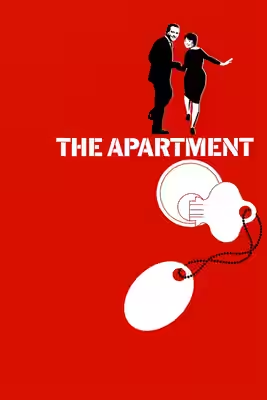
The Secret of My Success offers a more reassuring fantasy of office advancement than The Apartment, which we recommend for sharper jokes and more feeling. Both connect professional ambition with romantic complications, but Fox’s star vehicle relies heavily on his charm, while Billy Wilder’s office romance gives its characters’ unhappiness more attention.
What should I watch after The Secret of My Success?
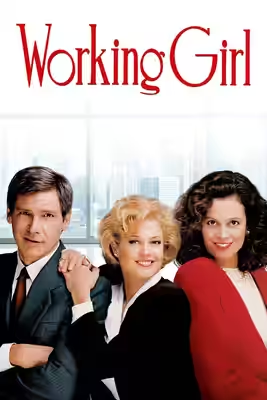
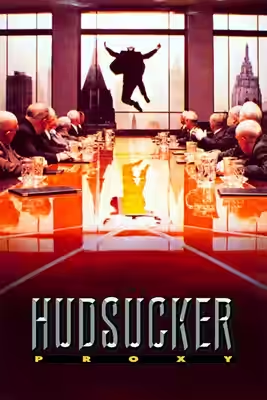
After The Secret of My Success, try The Apartment (1960, Fi1m 91): Office ambition and romantic compromise, with sharper jokes and far less reassurance. Then Working Girl (1988, Fi1m 80): Another bid to climb the office hierarchy, with stronger romantic chemistry; and The Hudsucker Proxy (1994, Fi1m 78): Corporate wish fulfilment pushed into stranger, more elaborately staged comic territory.

Cast

If you liked this, try…

  1. The Apartment (1960, Fi1m 91)Office ambition and romantic compromise, with sharper jokes and far less reassurance.

  2. Working Girl (1988, Fi1m 80)Another bid to climb the office hierarchy, with stronger romantic chemistry.

  3. The Hudsucker Proxy (1994, Fi1m 78)Corporate wish fulfilment pushed into stranger, more elaborately staged comic territory.

  4. How to Get Ahead in Advertising (1989) · not reviewed yetFor a nastier British view of career ambition and its unpleasant consequences.

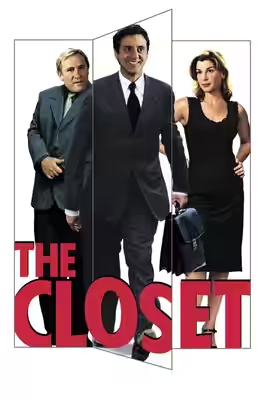
  5. The Closet (2001) · not reviewed yetA French workplace comedy where an invented identity causes practical complications.

Free account

Know what to watch tonight

Two lists that know where things are streaming, collections you can share, your own score beside ours, and Discover that remembers what you have seen.

  • Want to see, sorted by what is streaming now
  • Seen, with your score out of ten
  • No adverts, ever