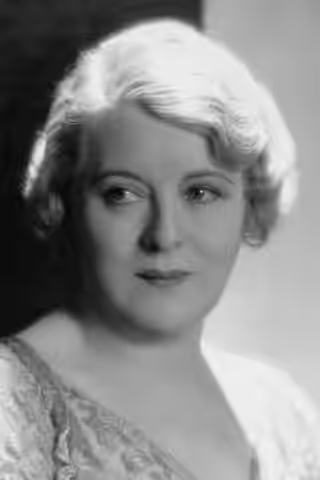
Mary Boland spent most of thirty years on the stage before Paramount put her in feathers in 1931, and then a decade playing the wife or mother whose ambitions outrun her sense. She is funniest when she is in earnest, which is nearly always.
Fi1m perspective
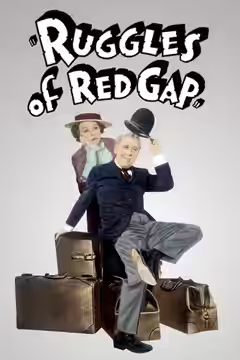
Effie Floud cannot say Paris without adding a syllable. In Ruggles of Red Gap (1935) she has been abroad and means everyone in Red Gap to know it, and Mary Boland plays the line, and the dozen like it, as if nothing about it were a joke. That is the whole method. Boland's women want to be grander than they are and have not the faintest suspicion that anyone finds this amusing, and she never winks at us over their heads. Travis Banton buried her in feathers and fur for Leo McCarey and she wore them as if they were owed to her.
She came to it late. Boland was a stage actress from 1901, in stock companies and then on Broadway from 1907, with a stretch in silent films between 1915 and 1920 before she went back to the theatre. Paramount signed her in 1931, and for the rest of the decade she was the studio's wife and mother of choice: Mrs. Peabody in If I Had a Million (1932), the matriarch who loses the family fortune in Three-Cornered Moon (1933), Effie in Ruggles. Fourteen of her films put her opposite Charles Ruggles, whose easy, trouser-hitching warmth was the right partner for her fluster; in Ruggles of Red Gap he is the film's warm centre and she is the reason he keeps sneaking off to get drunk. Later came the Countess De Lave in The Women (1939) and Mrs. Bennet in Pride and Prejudice (1940), the two parts people tend to remember her by, and she was still on Broadway in 1954.
What works is the conviction. We laughed at Effie every time she opened her mouth and were surprised, by the end of the film, to find we were fond of her, and that is Boland's doing: she plays each small social panic as though it mattered exactly as much as it does to Effie, and the film's affection for the woman grows out of that. Boland never asks us to hate her, and we did not. What does not work is the sameness. Hollywood gave her one part and asked for it again, and the ditzy, socially ambitious matron is a supporting role by definition; she was rarely allowed to carry anything. Her admirers say she was the one you watched in a crowded scene, and we believe it, but a career of crowded scenes is a career in other people's films.
In 1926 she told an interviewer, "I’m not a bit funny, off stage." We can believe that too. The comedy is in how seriously she took women nobody else did. Start with Ruggles of Red Gap, which gives her the most room, and then go and find the Countess.
Biography
Mary Boland, also credited as Marie Anne Boland, was an American stage and film actress. Born in Philadelphia, Pennsylvania, she was the daughter of an actor and began performing on stage as a teenager. She made her Broadway debut in the mid-1900s and appeared in numerous productions before entering silent films in 1915.
After a period focused on theatre, Boland returned to film in the early 1930s under contract with Paramount. She became known for supporting roles as flighty or socially ambitious matrons. Her credits include If I Had a Million (1932), Ruggles of Red Gap (1935) as Effie Floud, The Women (1939) as the Countess De Lave, and Pride and Prejudice (1940) as Mrs Bennet. She continued working in film, stage and television until the mid-1950s.
Boland died in New York City on 23 June 1965.