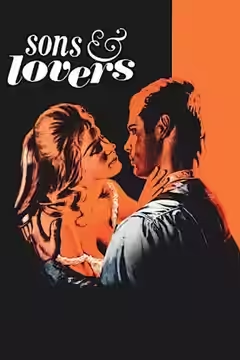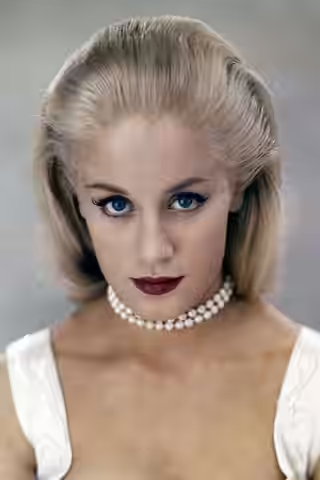
Mary Ure made few films and most of them did not know what to do with her. A stage actress first, she brought a wary, watchful stillness to the screen, and in Sons and Lovers (1960) she has more life than the picture around her can use.
Fi1m perspective
Clara Dawes walks into Sons and Lovers (1960) from the factory floor and the film brightens for as long as she is in the frame. Jack Cardiff's Lawrence is tidy where the book is raw, and Dean Stockwell's Paul is a passenger in his own story; Ure gives Clara an appetite the script has not written for her. She does it with little. A look held half a second too long, a line delivered flat where another actress would have pressed on it. Those enormous eyes do most of the work, and what they carry is wariness, as if she has already worked out how this will end. Freddie Francis photographs her handsomely, and then the picture goes back to Paul. We wanted it to leave the kitchen and follow her out of the door, and it never does, which is the one thing about the film we still hold against it.
The screen was never her first address. She trained at the Royal Central School of Speech and Drama, made her London stage debut in 1954 and two years later was Alison Porter in John Osborne's Look Back in Anger, the part she took to Broadway and then to the 1959 film opposite Richard Burton. Her Ophelia, her Desdemona, her Titania and a Stratford season in 1959 all happened where a camera could not follow. The films came in between: The Mind Benders (1963), Where Eagles Dare (1968) with Burton again, A Reflection of Fear (1972). Four of them she made with Robert Shaw.
What she brought over from the stage was poise and a refusal to raise her voice. She could be remote, and in the wrong hands that read as coldness. In the right ones it gave us a woman thinking, on camera, in front of men who assumed she was not. It suited literary adaptation, where a face can be trusted to carry what the dialogue has left out, and by most accounts it gave Where Eagles Dare a human weight the plot did not require but was better for. We have not reviewed it, so we will leave the claim there.
She said, on the set of that film, that she liked screen work: "I think it's the stimulus of every day something being different and I enjoy the short takes". The cinema did not return the interest as often as it should have. She made few films, and the reputation that survives is mostly a stage one, kept alive by people who saw her in rooms the rest of us cannot enter. Start with Sons and Lovers, and watch Clara rather than Paul. Then notice how much of the picture is spent waiting for her to come back.
Biography
Mary Ure (18 February 1933 – 3 April 1975) was a Scottish actress of stage and film. Born in Glasgow, she trained at the Royal Central School of Speech and Drama. She made her London stage debut in 1954 and appeared in productions including Look Back in Anger (1956) and a season at Stratford-upon-Avon.
Ure transferred her stage role as Alison Porter to the 1959 film adaptation of Look Back in Anger. She played Clara Dawes in Sons and Lovers (1960), for which she received nominations for the Academy Award and Golden Globe Award for Best Supporting Actress. Other film credits include Where Eagles Dare (1968). She was married to playwright John Osborne and later to actor Robert Shaw.