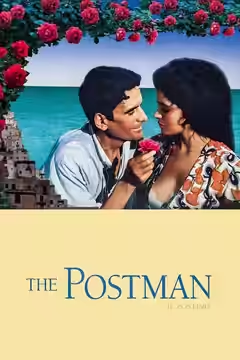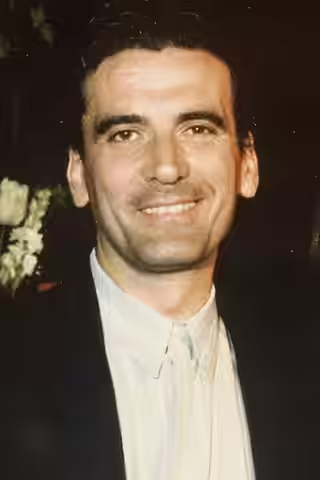
Troisi acted by waiting. He slouched, blinked slowly and let sentences fall apart halfway through, and he made a shy man's silence carry more than most actors manage with speeches. The Postman (1994) is the one we know best, and it makes the case.
Fi1m perspective
Watch Mario Ruoppolo hold his cap in The Postman (1994). He holds it as if someone might take it off him, and he sits down whenever the scene allows. Nobody else on screen listens as hard. When he speaks, the words arrive one at a time, and Michael Radford, who wrote the screenplay with him, built the whole film round that. It is a performance made of pauses, and it is nearly all the film has.
The pauses were not new. Troisi came up through Neapolitan cabaret and theatre in the late 1960s and early 1970s, then television at the end of that decade with the comedy group La Smorfia, alongside Lello Arena and Enzo Decaro. The manner was already there: the face doing the work, the sentence that hesitates and gives up, timidity played straight rather than for a fall. He worked in a line that runs back through Totò and Eduardo De Filippo, and he is often called the comedian of feelings, which sounds soft and is accurate. His men are shy, unsure of their work and worse at love, and the comedy is in watching them not manage.
The career divides cleanly. In 1981 he wrote, directed and starred in Ricomincio da tre, a semi-autobiographical comedy that set the pattern: a young man with more doubt than plan. Through the 1980s he directed and co-wrote more, most of it with the screenwriter Anna Pavignano, who worked on five of his films, and once with Roberto Benigni on Non ci resta che piangere (1984), a time-travel comedy the two of them co-directed. Ettore Scola put him next to Marcello Mastroianni in Che ora è? (1989), and that is the film people point to when they want to say he could do more than be funny. We have not reviewed it and will not pretend to have judged it. The Postman was his last, and it was released after his death.
The stillness is also the risk. An actor who does this little can look like a man who has simply turned up, and the difference is timing. Troisi had it. There is a scene in The Postman where Mario carries a tape recorder round the island collecting sounds for the poet, waves and wind and a church bell and his own held breath, and holds the microphone out to the sea the way you would offer a drink to a friend. It moved us more than a man with a microphone had any right to, because he plays it as though the sea might answer and he would not be surprised. Philippe Noiret's Neruda has all the words; Troisi has the listening, and the listening wins.
We gave The Postman 75, not more, because it is slight in places and the music leans too hard on the ending, and none of that is Troisi's doing. If the manner is yours, start there, on an evening with nothing pressing. Then go back to 1981 and watch him invent it.
Biography
Massimo Troisi (19 February 1953 – 4 June 1994) was an Italian actor, screenwriter and film director. He began his career in cabaret and theatre before gaining prominence on television with the comedy group La Smorfia in the late 1970s. He made his feature debut as director, writer and star with I'm Starting from Three (1981).
Troisi directed and starred in several further comedies, including Sorry for the Delay (1983) and Nothing Left to Do But Cry (1984). He also appeared in films by Ettore Scola, such as What Time Is It? (1989). His final role was as Mario Ruoppolo in Michael Radford's The Postman (1994), for which he also received a screenplay credit. He postponed heart surgery to complete filming and died of a heart attack twelve hours after shooting ended.
Troisi received posthumous Academy Award nominations for Best Actor and Best Writing (Screenplay Based on Material Previously Produced or Published) for The Postman.