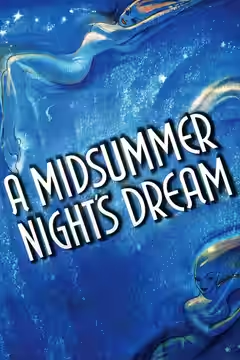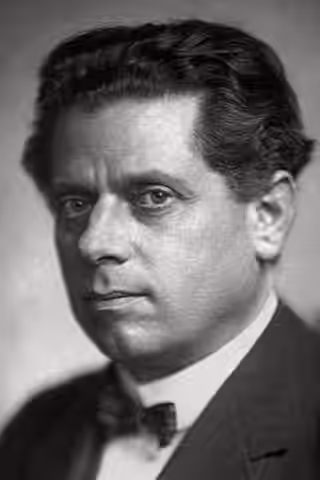
Max Reinhardt made one sound film, a Midsummer Night's Dream he had been staging for thirty years, and it is good exactly where it is most like his theatre: in the wood, at night, with the lights doing the acting. Elsewhere it creaks.
Fi1m perspective
The best thing in the 1935 A Midsummer Night's Dream is the wood at night. The fairies drift through gauze and glitter, the dark closes round them, and for a few minutes a Warner Bros. sound stage looks like nowhere else in Hollywood. That is Max Reinhardt's stagecraft, moved indoors and photographed. He had been building revolving stages and lighting rigs in Berlin for thirty years by then, and he once put the whole method in a sentence: "The art of lighting the stage consists of putting light where you want it and taking it away from where you don't want it." The film is good when it does that and worse when it stops.
Reinhardt was a director of the theatre who made one sound film, so a view of his cinema is a view of one evening. He started as an actor in Vienna and Salzburg, turned to directing in Berlin around 1902 to 1905, ran the Deutsches Theater, co-founded the Salzburg Festival in 1920, and staged the Dream first in 1905 and then again and again for the rest of his working life. It was his signature piece. He put it on at the Hollywood Bowl in 1934, and the studio version followed a year later, with William Dieterle, one of the film-makers who had learned from him, sharing the director's credit.
What the film has is what the stage had. The fairy scenes are lovely to look at, the tradesmen's play is the stretch to wait for, and James Cagney's Bottom is the performance to see it for. What it lacks is the thing a theatre lets you forget, which is a close-up. The studio filled the parts with its contract players, people better known for gangster pictures and musicals; Cagney, Brown and de Havilland could speak the verse and several of the others could not, and when the lovers stand still and recite, the camera gives us nothing to look at but their effort. Puck is loud. Mendelssohn runs under nearly all of it. We sat forward each time the wood filled the screen and sat back, slightly embarrassed on everyone's behalf, each time the young Athenians opened their mouths, and the film kept doing that to us for 143 minutes. Critics at the time and since have said much the same in politer terms: the spectacle is his, and he never quite worked out what to do with it once it was on film.
Reinhardt's larger mark on cinema is not this film. Ernst Lubitsch, F.W. Murnau and Dieterle are among those who learned from him, and what they took away is in a great many films he had nothing to do with. Watch the Dream late, with the lights off, and be patient with the lovers; you are seeing the last of one stage tradition and the beginnings of several film ones at once.
Biography
Max Reinhardt was an Austrian theatre and film director. Born Maximilian Goldmann on 9 September 1873 in Baden bei Wien, he became one of the leading figures in German-language theatre in the early twentieth century, known for innovative stage productions of Shakespeare and other classics.
He directed the 1935 Warner Bros. adaptation of A Midsummer Night's Dream, co-directed with William Dieterle. Reinhardt had staged the play multiple times on stage, including a 1934 Hollywood Bowl production that informed the film. He fled Nazi persecution in the 1930s and worked in the United States until his death in New York on 30 October 1943.