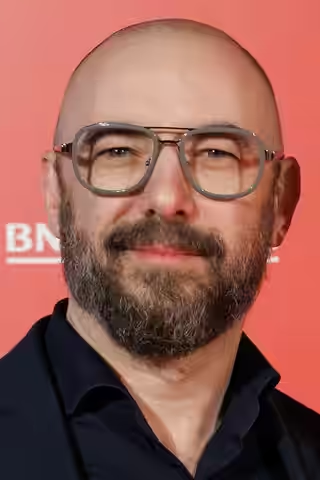
Roskam makes crime films about men who have damaged themselves before anyone else gets the chance, and he composes them like the painter he trained as. The Belgian films are where the intensity lives; the American work is tidier and, on the record so far, less his.
Fi1m perspective
The men in Michaël R. Roskam's films are already in trouble when we meet them. Jacky in Bullhead (2011) is a farmer pumping himself with the same steroids he sells into the illegal hormone trade. The barman in The Drop (2014) minds a Brooklyn bar that holds other people's money. The gangster in Racer and the Jailbird (2017) falls for a racing driver and cannot tell her what he does. In each the crime is the setting and the man is the subject, and Roskam frames him with a stillness that comes from a training in painting rather than in film. He has said he learned editing from comics, and the shots do have that quality of panels, each one held long enough to read.
The career runs in two directions at once. He wrote and directed Bullhead, which made Matthias Schoenaerts an international name and Roskam with him. He went to America for The Drop, from a Dennis Lehane script, with Tom Hardy and James Gandolfini in his last role. Then he went home to Brussels for Racer and the Jailbird, the second part of a loose Belgian trilogy. Since then there has been television: Berlin Station (2016) and the first three episodes of Black Bird (2022), Lehane again.
He keeps his people. Schoenaerts, the cinematographer Nicolas Karakatsanis and the composer Raf Keunen have each done three films with him, and the consistency of the look is theirs as much as his. What works is the single wounded man watched closely, which is why Bullhead is the film everyone starts from. What works less well, and most critics have said so, is the romance: Racer and the Jailbird asks a love story to sit inside a heist film and the two do not settle, and The Drop is a well-made Lehane adaptation that could have been made well by several other people. Roskam is a director of temperament rather than plot, and when the plot takes charge the temperament goes quiet.
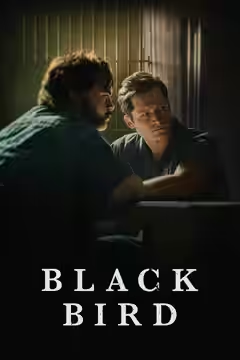
Black Bird, which we scored 78, is the one of his we have reviewed, and he shares it with Jim McKay and Joe Chappelle, who together hold one look across six episodes, which is rarer than it sounds. We found the cell-block conversations hard to sit through, in the right way, because Paul Walter Hauser talks about what he did to girls in the tone other men use for fishing. The series is careful with its victims, giving Jessica Roach a bicycle and a summer before it gives her a case number, and that care is recognisably Roskam's: the harm matters more than the mechanics.
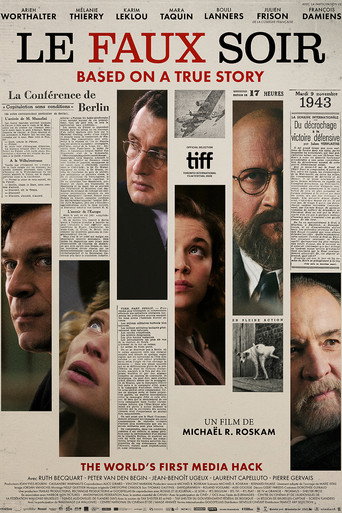
Next is Le Faux Soir, a wartime film he says he does not want to be a satire: a realistic film about realistic, funny people risking their lives. A director of glum, muscular men making something funny is either a departure or a confession. We would like to see which.
Biography
Michaël R. Roskam is a Belgian film and television director. He was born Michaël Reynders on 9 October 1972 in Sint-Truiden, Belgium. He studied painting and contemporary art at the St Lucas Academy of Fine Arts in Brussels and later graduated from the Binger Film Institute in Amsterdam with a master's degree in script writing and development.
Roskam began his career with short films including Haun (2002), Carlo (2004) and The One Thing to Do (2005). His feature debut Bullhead (2011), which he also wrote, received an Academy Award nomination for Best Foreign Language Film. Subsequent features include The Drop (2014) and Racer and the Jailbird (2017). He directed three episodes of the miniseries Black Bird (2022).