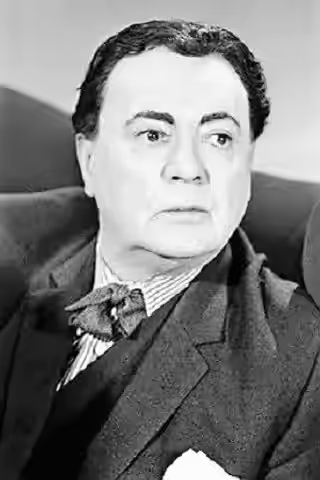
A lifetime on stage and almost nothing on film, and one performance that makes the loss felt. His Iago for Orson Welles is small, dry and unsmiling, and he needs only a walk along a wall to undo a man.
Fi1m perspective
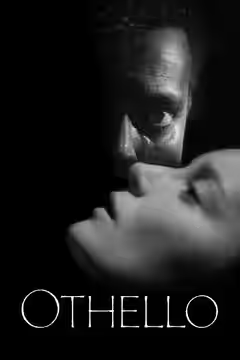
The best thing Micheál Mac Liammóir does in Orson Welles's Othello (1951) is walk. Iago and the Moor go side by side along the ramparts, the sea below, the camera keeping pace, and Iago says less than he means for the length of a wall. Most Iagos twinkle at the audience; this one is small, dry and unsmiling, a clerk who has been slighted and has all afternoon. We found the scene frightening, and it took us a while to work out why: nothing happens in it. By the end of the wall Othello is a different man, and Mac Liammóir has barely raised his voice.
Welles cast him older than the part is usually played, and meant to. This Iago is impotent and eaten by envy rather than clever and amused. Reviewers noticed the age; we think it is the point. A young Iago is a gamesman. An old one has nothing left to lose and knows it, and Mac Liammóir carries that knowledge in the set of his mouth. He wrote a memoir of the shoot, Put Money in Thy Purse, and the film, dubbed and stitched together wherever Welles found money, is one of the few substantial screen records of him.
That is the odd thing about his career as we can see it. He was a Londoner, born Alfred Willmore, on the English stage as a child from 1911, and by the end of the 1910s he had moved to Ireland, taken a new name and a Cork history that was not his, and begun playing an Irishman full-time. In 1928 he founded the Gate Theatre in Dublin with Hilton Edwards, and over the following decades he acted in, wrote for or designed nearly 300 productions there, offering Wilde, Shaw and Ibsen to a city whose other theatre had different concerns. His Hamlet in the West End in 1935 helped make the company's name abroad. Almost none of this was filmed.
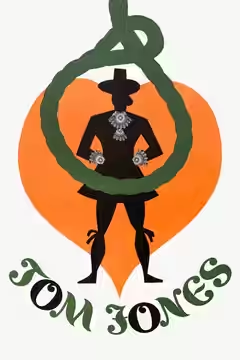
What was filmed suggests what we missed. The intelligence critics found in his Hamlet and his Brack in Hedda Gabler is, on the evidence of Othello, a cold one, and it photographs well. His writing was another matter, and plays such as Ill Met by Moonlight were found discursive and obscure by the people who sat through them. From 1960 he turned himself into a solo act, and his one-man show about Wilde ran for over 1,300 performances around the world. He also narrated Tom Jones (1963), so there is at least one film in which the voice arrives without the face.
For anyone deciding what to watch, the choice is simple. There is one film that matters, and in it he is good in a way that is hard to describe and easy to feel. See Othello, wait for the wall, and notice how little he needs to do.
Biography
Micheál Mac Liammóir (born Alfred Lee Willmore) was an English-born actor, designer, playwright and impresario. He began his career as a child actor on the London stage under his birth name before moving to Ireland in the 1920s, adopting an Irish persona and co-founding the Gate Theatre in Dublin with Hilton Edwards in 1928.
He appeared in numerous stage productions and wrote plays and autobiographies. His film roles include Iago in Orson Welles’s Othello (1951), the narrator in Tom Jones (1963), Sweet Alice in The Kremlin Letter (1970) and Hamilton Starr in What’s the Matter with Helen? (1971). He also created and performed the one-man show The Importance of Being Oscar.
Mac Liammóir died in Dublin on 6 March 1978.