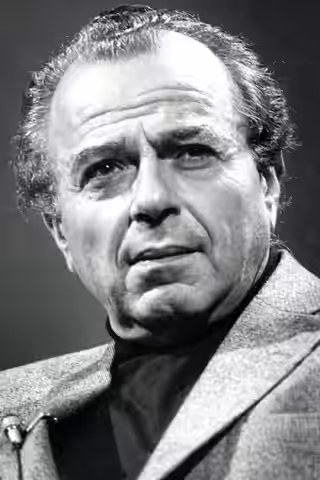
Michael Cacoyannis put Greek tragedy on screen with the force of the stage and the stillness of a landscape, and cut his own films, which is where they go wrong. His best work is with Irene Papas and Walter Lassally.
Fi1m perspective
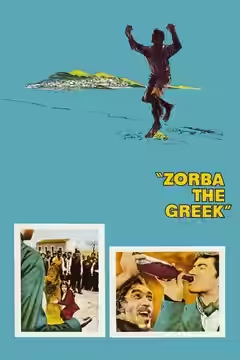
A widow walks through a Cretan village and Cacoyannis refuses to look at her. He cuts instead to the men watching, one face after another, and then to the boy trailing her at a distance. That is Irene Papas in Zorba the Greek (1964), and in under a minute of film she has become the reason to sit through all 142. Nobody has laid a hand on her yet, and we felt sick, because the cutting had already told us what the village would eventually do. It is Cacoyannis at his strongest: a face, a bare hillside, a rhythm, and no talking to get in the way.
He arrived in Athens in 1952 after law and drama in London and a spell at the BBC Greek service, and his early films, Stella (1955), which launched Melina Mercouri, and A Girl in Black (1956), made his name at home. Then came Euripides, three times over: Electra (1962) with Papas, The Trojan Women (1971) with an international cast, and Iphigenia (1977). Zorba, which he wrote, produced, directed and edited, sat between them and carried Greek cinema to audiences who had never seen any. He also made Attila '74 (1975), a documentary on Cyprus, and worked extensively for the stage and the opera house, which tells you something about where his instincts lay.
His best collaborators were behind and in front of the camera. Walter Lassally shot three of his films, and the Crete of Zorba is the argument for the partnership: stone, light and weather, with the people small against them. Papas made five films with him, and Electra already knew what to do with her stillness before Zorba found it again. Mikis Theodorakis scored two. The weak link was Cacoyannis himself at the editing bench. He cut his own films in a percussive style he took from Russian silent cinema, and when it works it is the widow's walk; when it does not, as in most of Zorba, scenes begin without warning and stop when he has had enough of them, and the friendship the film is supposedly about is the strand he develops least.
Most critics found the later Euripides films ponderous and too theatrical, and the complaint is consistent enough to be worth passing on: a man of the theatre who could not always tell when the camera had already done the work. His post-Zorba features were, by and large, received coolly. We can only speak for Zorba, where two actresses give performances of real weight and Anthony Quinn keeps walking in front of them.
Start with Electra, then watch Zorba for Papas and for Lila Kedrova, and take a breath when the dance begins. He is remembered for the two minutes he had least reason to be proud of.
Biography
Michael Cacoyannis was a Cypriot and Greek film director, screenwriter, producer and editor. He was born in Limassol, Cyprus, and studied law in London before working for the BBC Greek Service and training in acting and directing. He settled in Athens in the early 1950s and made his first feature film in 1953.
Cacoyannis directed, wrote, produced and edited the 1964 film Zorba the Greek, an adaptation of the novel by Nikos Kazantzakis. He also directed stage productions including the 1983 Broadway revival of the musical version. His other notable films include adaptations of Euripides plays: Electra (1962), The Trojan Women (1971) and Iphigenia (1977). He received five Academy Award nominations, including three for Zorba the Greek.
In 2003 he founded the Michael Cacoyannis Foundation in Athens to promote theatre and cinema. He died in Athens in 2011.