Miklós Jancsó builds his historical films around bodies and a camera in motion. We value their sustained pressure, though the severe choreography can keep the people at a distance even when their danger holds our attention.
Fi1m perspective
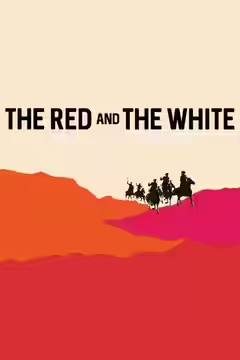
The camera keeps moving in The Red and the White (1967), and it does little to put us at ease. Jancsó builds long takes around groups crossing open ground, with the camera tracking, circling and finding a new position. We have to watch where people stand and how their control over others changes. This is demanding filmmaking, worth the effort for its sustained pressure, though the severity can become tiring.
Cinematographer Tamás Somló is an essential collaborator here: the movement through space supplies much of the drama. We felt persistently uneasy watching The Red and the White, because the restless camera makes it difficult to relax while lives remain at risk. There is little stirring spectacle to soften that experience, and Jancsó does not make individual psychology his priority. The cost is that the people can remain distant even when their danger holds our attention.
The approach had brought international recognition with The Round-Up (1966), also shot by Somló. Longstanding screenwriter Gyula Hernádi was another important collaborator in a cinema that gives more attention to pursuit, humiliation and changing allegiances than to private motives. János Kende began shooting for Jancsó with Silence and Cry (1968). The Confrontation (1969), his first colour film, made song and dance more prominent. By Red Psalm (1972), also photographed by Kende, folk songs and ritual were central to the action.
The danger is that the movements become more interesting than the people making them. Some later work drew precisely that criticism, with ritual and nudity seeming arbitrary in Elektra, My Love (1974) and other films of the period. He worked in Italy in the mid-1970s. The satirical comedies he made with recurring actors in the 1990s and 2000s are a useful warning against treating his severe historical films as the whole career.
For a first encounter, we would choose The Red and the White. Its 90 minutes offer concentrated tension, but the distance from the characters remains a substantial obstacle. Save it for an evening when a war film without conventional excitement sounds like a welcome proposition.
Biography
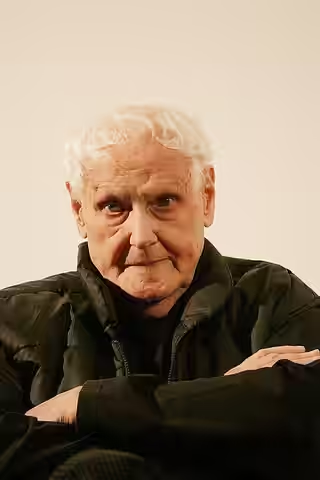
Miklós Jancsó was a Hungarian film director and screenwriter. Born in Vác in 1921, he studied law before graduating from the Academy of Drama and Film Arts in Budapest in 1950. He began his career making newsreels and documentaries before directing his first feature film in 1958.
Jancsó directed and co-wrote The Red and the White (1967) and directed Red Psalm (1972). He is also known for The Round-Up (1966). Red Psalm won him the Best Director prize at the 1972 Cannes Film Festival. He received the Kossuth Prize in Hungary in 1973 and a Golden Lion for lifetime achievement at the Venice Film Festival in 1990.
Jancsó died in Budapest in 2014.