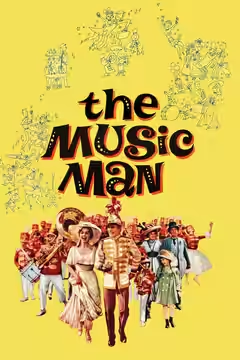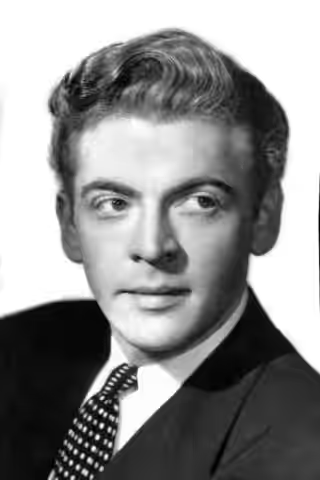
Morton DaCosta filmed his own Broadway hits with the staging left where it stood, which kept the shows whole and stopped them ever quite becoming films. The Music Man is the best of it, and Robert Preston is why.
Fi1m perspective
At the end of several numbers in The Music Man (1962), the lights go down around the singer until only a face is left, and then the screen goes black. It is a stage effect, and it is there on purpose. Morton DaCosta had staged the show on Broadway in 1957, where it ran for more than four years, and he brought it to film with Robert Preston, Meredith Willson's score and most of the jokes intact. He directed it as a man who knew where every laugh fell, because he had heard them land on Broadway for four years.
He was an actor first, with a Broadway debut in The Skin of Our Teeth in 1942, and did not direct until The Grey-Eyed People in 1952. Then came the hits, one after another through the middle of the decade: Plain and Fancy, No Time for Sergeants, Auntie Mame, The Music Man. When two of them went to Hollywood he went with them, producing and directing Auntie Mame (1958) with Rosalind Russell and The Music Man four years later. In both cases the job was to get the show onto film without breaking it, and he did it.
That is a real skill and the film shows what it buys. Every number survives, including the barbershop quartet of bickering school board members who cannot agree on anything until Hill gets them singing. Robert Burks shoots a full-size town square in July sunshine, Dorothy Jeakins puts the women in hats a pigeon could nest in, and Preston is allowed to do the part he had already done on Broadway. We sat up every time Preston started selling and slumped a little every time he stopped, because DaCosta had built the whole picture around him and had little to offer when he was off the screen.
What it costs is the other thing. The film runs 151 minutes, a good half hour longer than it needs to, and it never becomes a film in the way Singin' in the Rain or Meet Me in St. Louis did. It is a photographed play, a handsome one. Island of Love (1963), his third film, was by most accounts a lesser one, and in 1968 he was taken off Mrs. Brown, You've Got a Lovely Daughter after a month of shooting. That was the end of him in Hollywood. He went back to the theatre and kept working there until Doubles in 1985; he had tried to slow down before that, and told the New York Times in 1982 that "after a little while I felt that retirement was death."
See The Music Man for Preston and for the square, and watch what happens when a number ends. The lights go down, one face is left, the frame goes black, and for a second you are back in the theatre he took it from, which is also where he went when the films stopped.
Biography
Morton DaCosta was an American theatre and film director, producer, writer and actor. Born Morton Tecosky in Philadelphia, he began his career as an actor on Broadway in the 1942 production of The Skin of Our Teeth. He made his stage directing debut with The Grey-Eyed People and achieved success in the 1950s with Broadway productions including Plain and Fancy, No Time for Sergeants, Auntie Mame and The Music Man.
DaCosta directed and produced the film adaptations of Auntie Mame (1958) and The Music Man (1962). He also directed the 1963 film Island of Love. His stage work on The Music Man earned a Tony Award nomination for Best Director of a Musical, and the film version received Academy Award and Golden Globe nominations in several categories, including Best Picture as producer.