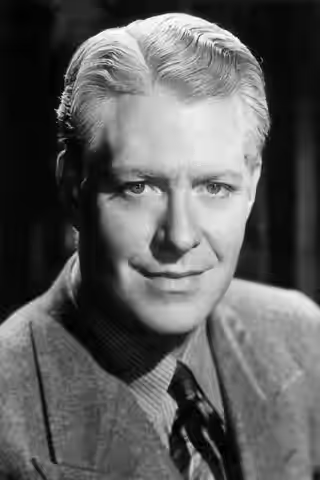
A concert baritone handed a tricorn and a camera who never worked out what to do with either. The voice is one of the great sounds of the studio musical; the man attached to it stands where he is put and waits for his cue.
Fi1m perspective
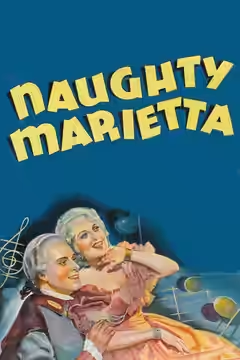
Nelson Eddy sings the way other actors act: the whole man arrives in the sound. Watch him in Naughty Marietta (1935) and the pattern is set in the first reel. The baritone comes out enormous, warm and without visible effort, and while it is coming out he is entirely present. Then the music stops, Captain Richard Warrington has to say something to Jeanette MacDonald, and his arms hang and his face goes blank until the orchestra rescues him. We wrote at the time that he wooed her like a lamppost in a tricorn, and nothing we have seen since softens it.
The career explains the habit. Eddy was an opera and concert singer first, with the Philadelphia Civic Opera and on the recital platform in the 1920s, and MGM signed him in 1933 after a Los Angeles concert success. Naughty Marietta was the breakthrough, and it began eight films with MacDonald that ran to 1942: Rose Marie (1936), with Eddy as a Mountie, and Maytime (1937) are the ones people still name. When the partnership ended he went to Universal for Phantom of the Opera (1943), voiced several parts in Disney's Make Mine Music (1946), and then went back to where he had started, concerts and radio and later television and nightclubs, until his death in 1967. The screen was an interlude in a singing life, and it shows.
What works is the sound and the pairing. MacDonald's soprano sits on top of his baritone and the two sounds fit, and the films were built to bring the voices together and get out of the way. W. S. Van Dyke, who directed three of them, understood that: he lets the numbers run and does not ask Eddy to carry a scene in between. The complaint has followed Eddy from the start, that he is wooden, and we cannot argue with it. What we can add is that the woodenness is oddly honest. He never pretends to a feeling he has not got a tune for.
We were got at anyway. There is a duet late in Naughty Marietta that the film has been teasing in pieces from the start, and when it finally arrives whole we stopped minding the lamppost, because Victor Herbert wrote a melody that does the acting and the two of them have the sense to let it. For a few minutes the film's calculation and its feeling are in the same place. That is the Eddy experience in miniature: a long patient wait, then the sound, then it is over.
Come to him for the singing and bring no other expectations. He is best met at home with the volume up, where you can attend to the numbers and make the tea during the wooing, and where his stillness reads less as a failure of acting and more as a man politely waiting to be allowed to do his job.
Biography
Nelson Eddy (1901–1967) was an American singer and actor who appeared in 19 musical films in the 1930s and 1940s, as well as in opera, on the concert stage, radio, television and in nightclubs. A classically trained baritone, he made his screen debut in small roles before achieving success as Captain Richard Warrington opposite Jeanette MacDonald in Naughty Marietta (1935).
Eddy and MacDonald went on to star together in seven further films, including Rose Marie (1936), Maytime (1937) and I Married an Angel (1942). He is also known for roles in Phantom of the Opera (1943) and the voice of the whale in the segment "The Whale Who Wanted to Sing at the Met" in Make Mine Music (1946). During his career he received three stars on the Hollywood Walk of Fame, three gold records and sang at the third inauguration of President Franklin D. Roosevelt.