Norman Taurog spent nearly fifty years getting children and stars to relax in front of a camera. His films are easy, good-tempered and rarely in doubt about anything, and Boys Town is the case for him and against him at once.
Fi1m perspective
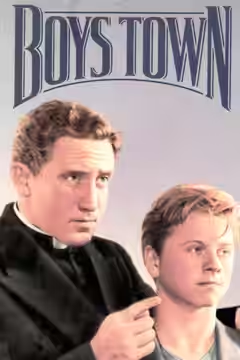
Mickey Rooney walks into Boys Town (1938) about halfway through with a cigar in his teeth and his hat pushed back, and for twenty minutes it is a pleasure to watch him try to sneer at people who will not be sneered at. Then it goes on. Norman Taurog lets him keep that one setting long after the boy underneath should have shown through, and that is Taurog in miniature. He makes a young performer comfortable and then he leaves him be.
He had been a child actor himself, on stage from 1907, and he came to directing by way of props, assisting and writing before his first shorts in 1920. Skippy (1931) made his name and fixed his reputation as the man to send children to, and he directed his nephew Jackie Cooper twice. Young actors called him Uncle Norman and he paid them in chocolate for a good take. "They just walk on the set and do what I tell them. I love them all," he said in 1951, which is affectionate, slightly alarming, and explains the Rooney problem. A director who loves them all does not often ask for more.
The MGM years, 1938 to 1951, are the ones to look at. Boys Town and The Adventures of Tom Sawyer came in the same year, and Broadway Melody of 1940 put Fred Astaire and Eleanor Powell together in one of the studio's big pre-war musicals. What he gave stars was room. Spencer Tracy plays Father Flanagan with a patience that never tips into piety, and we were moved by him well beyond what the script had earned. It is the patience that does it: he waits for these boys in a way the film never has to, since it has already decided none of them can fail. When Tracy leaves the screen there is nothing left to test, and it shows.
After MGM he built a second career on other people's personalities. Six comedies with Dean Martin and Jerry Lewis, then nine films with Elvis Presley, from G.I. Blues (1960) through Blue Hawaii (1961), more than any other director made with him, and the pattern they set became the pattern for every Elvis film after. The complaint against them is that they are light and all alike, and the complaint is fair. But it is the same virtue in a smaller frame: a nervous star, a director who makes him easy, a picture that goes down without an argument. He retired in 1968 and taught at USC, which seems right for a man whose gift was putting people at ease.
Start with Boys Town, for Tracy, and watch what Taurog does with the boys and what he does not. He will not let one of them fail. That is kind of him, and it is also why the film never quite persuades.
Biography
Norman Taurog was an American film director and screenwriter. He began his career as a child actor on stage before moving into film work as a prop man, editor and director of short comedies in the 1920s. His first feature film was Lucky Boy (1928).
Taurog directed over 140 films between 1920 and 1968. He won the Academy Award for Best Director for Skippy (1931) and was nominated for Best Director for Boys Town (1938). He directed nine films starring Elvis Presley, including G.I. Blues (1960), Blue Hawaii (1961) and Girls! Girls! Girls! (1962). For his contributions to cinema he received a star on the Hollywood Walk of Fame at 1600 Vine Street in 1960.