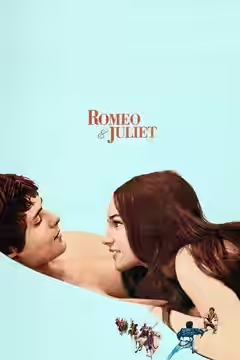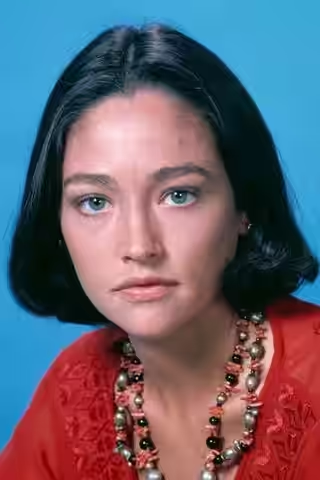
At fifteen Olivia Hussey played Juliet as a girl finding out something about herself while the camera watched, and nothing she did afterwards came close. The performance is the reason to know her name; the rest is worth an evening or two, no more.
Fi1m perspective
Watch the Capulet ball in Franco Zeffirelli's Romeo and Juliet (1968) and see what Olivia Hussey does while a boy sings Nino Rota's ballad about youth being a passing thing. She does very little. Zeffirelli cuts between her face and Leonard Whiting's across a crowded hall, and Hussey plays it as a girl who has just learnt something about herself and has not yet decided what to do with it. She was fifteen. We were moved by a scene we have seen played a dozen ways, because Hussey does not look like an actress showing us a discovery. She looks like a girl making one.
That is the performance, and nothing after it came close. Zeffirelli saw her on stage in The Prime of Miss Jean Brodie (1966), opposite Vanessa Redgrave, and put her in real Italian streets under a sun that made everyone squint. The fame came at once. What followed is a short, odd list. Black Christmas (1974) made her Jess Bradford, the lead in an early slasher, since taken as an early model for the horror heroine who keeps her head. Zeffirelli brought her back as Mary in Jesus of Nazareth (1977). She was Rosalie Otterbourne in the ensemble of Death on the Nile (1978). After that the work was mostly television, horror, voices for animation and games, and the title role in Mother Teresa of Calcutta (2003). Her last screen credit, Social Suicide (2015), put her beside Whiting again.
What she could do is on the screen in Verona, and so is what she could not. The verse gave her trouble. The balcony scene, played as two children whispering so as not to wake the house, is lovely, because the lines are short and she can treat them as talk. Give her a long speech and she leans on it. Zeffirelli cuts to her face rather than staying with her voice, and the film is at its best when he does. He came back to her, and other directors cast her as the Virgin Mary and as Mother Teresa, which is a compliment of a narrow kind. "If I am remembered only for Juliet, Mary and Teresa, that will be enough for me," she said. Whether it should be enough for us is a different matter. We would like to have seen more of the young woman she played in Black Christmas, the one who does the sensible thing under pressure, and to have seen her grow up on screen. That did not happen. What we have is one summer in Italy at fifteen, filmed by a man who knew exactly what he had, and it is the first half of that film we would send you to, for the ball and the balcony and a girl finding out.
Biography
Olivia Hussey was an Argentine-British actress. Born Olivia Osuna in Buenos Aires, she moved to England as a child and trained at the Italia Conti Academy of Theatre Arts in London.
She began acting professionally in her teens and was spotted by Franco Zeffirelli while appearing in a London stage production of The Prime of Miss Jean Brodie. This led to her casting as Juliet in Zeffirelli’s 1968 film adaptation of Romeo and Juliet, opposite Leonard Whiting. The performance brought her a Golden Globe Award for New Star of the Year – Actress.
Hussey appeared in films including Black Christmas (1974) and Death on the Nile (1978), and in television series and miniseries such as Jesus of Nazareth (1977) and It (1990). She also provided voice work for animated series including Batman Beyond (1999).