Ousmane Sembène's films put a community in the open air and let it argue about who it is going to be, with the camera held still and the anger held steady. The playing can be stiff; the argument is nearly always worth your evening.
Fi1m perspective
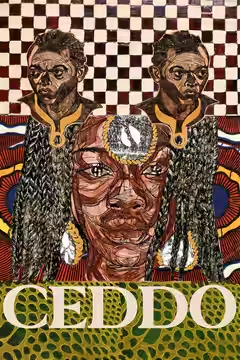
A clearing, a king, and everyone with a claim on the kingdom standing in the sun and taking turns. That is Ceddo (1978), and it is Sembène's method in miniature: people speak, and the speaking is the action. His cinematographer Georges Caristan, who also shot Emitaï and Xala (1975) for him, hardly moves the camera. You are placed at the edge of the crowd and expected to listen.
He came to the camera late and from the page. He had written novels through the 1950s and trained in filmmaking at the Gorky studios in Moscow around 1962, and his reason for switching is on the record: most of his countrymen could not read him, and a film does not need to be read. Borom Sarret (1963), a short about a day in the life of a Dakar cart driver, came first. Black Girl (1966) followed a Senegalese maid to France. Mandabi (1968) was the first feature shot in Wolof, a comedy about bureaucracy in a newly independent Dakar, and from there the 1970s films, Emitaï, Xala, Ceddo, took on the church, the mosque, the new elite and the slave trade, one village at a time.
The pattern held to the end. After a long quiet came Guelwaar (1992), Faat Kiné (2000) and the last film, Moolaadé (2004), shot in Burkina Faso. Sembène's women resist by doing the next ordinary thing rather than by making speeches, and the films are at their strongest when he trusts that.
What works is the clarity. He can take a century of history and get it into a single parable with a strong opening image, and he trusts an untrained face to hold a shot. What does not always work is the playing, which in Ceddo is often stiff, the actors reciting positions rather than living in them, and a spare visual style that sometimes shades into overexposure. We would not swap it for polish. Watching the white trader at the edge of the Ceddo clearing weigh captives against muskets as if he were buying millet, we were angry in a way few films have managed, and it was the flatness of the staging that did it. Sembène refuses to dramatise the trade because he wants us to see how undramatic it was.
Asked once whether his films were legible to European audiences, he answered: "Why be a sunflower and turn toward the sun? I myself am the sun." The films bear that out. They are not explaining Africa to anyone. Start with Xala, which lets you laugh at the men it is accusing, then go to Ceddo, which does not let you laugh at anyone.
Biography
Ousmane Sembène (1 January 1923 – 9 June 2007) was a Senegalese film director, screenwriter, producer and novelist. He directed and wrote Ceddo (1977) and Moolaadé (2004), and also produced the latter.
He is known for earlier works including Black Girl (1966), The Wagoner (1963), Mandabi (1968) and Xala (1975). Sources describe him as a pioneering figure in African cinema.