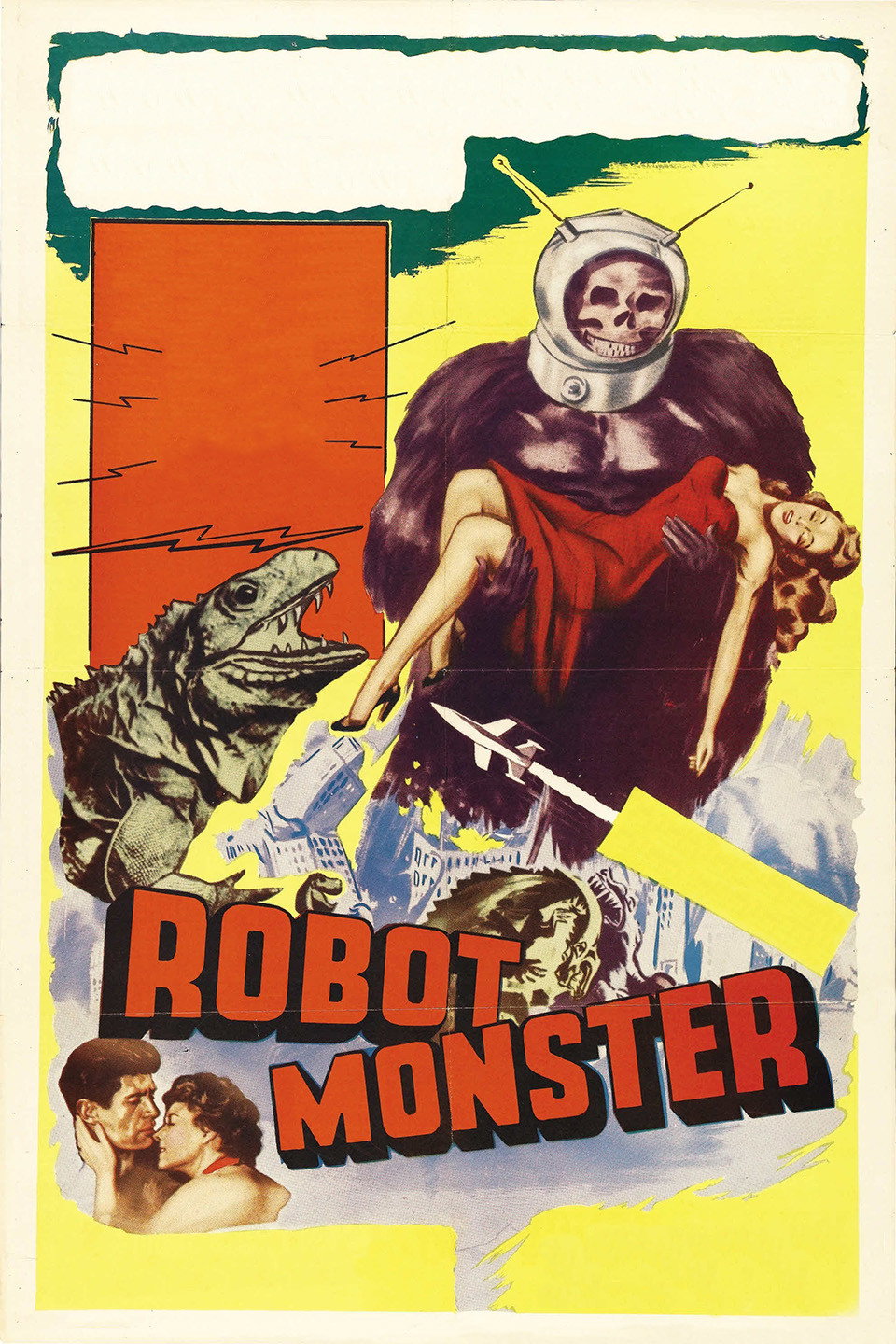
Phil Tucker’s Robot Monster has a memorable alien and a sluggish survival story. We respect the resourcefulness behind his filmmaking, but there is only so much pleasure to be had from watching a creature outclass the humans.
Fi1m perspective
In Robot Monster (1953), an ape-like alien charged with destroying Earth wears a helmet and antennae. The costume holds our attention more readily than the human characters do. We laughed at the creature, then grew bored with the conversations around it. Phil Tucker’s science-fiction horror has a durable attraction, but even at 66 minutes it cannot find enough to keep us interested. There is little sense in pretending that this is a good film merely because we remember what its monster looks like.
Tucker completed Robot Monster in four days, and that speed deserves some respect. The problem is not simply that the alien looks peculiar: a straightforward account of survival could have worked with it. Instead, the dialogue is dull beside the costume, and the stretches between moments of amusement feel padded. We wanted the film to work on its own terms before its shortcomings became the entertainment.
His directing work extended from early features such as Dance Hall Racket (1953) to the exploitation and burlesque of Broadway Jungle (1955). With The Cape Canaveral Monsters (1960), which he also wrote, he returned to an alien-invasion story. His collaborators included producer Al Zimbalist and writer Wyott Ordung. He subsequently moved into editing and post-production supervision, with credits including King Kong (1976). We would keep those later credits in mind before treating one conspicuous costume as the full measure of what he could do.
The habit of treating Tucker’s films as enjoyable failures makes Robot Monster sound more consistently entertaining than we found it. Its oddness offers amusement in brief spells; the slow stretches still have to be watched. There is room for affection here, particularly for the attempt to make a survival film around such an unlikely threat. Approach it for the creature, and keep expectations of the humans modest.
Biography
Phil Tucker (1927–1985) was an American film director, producer, writer and editor. He directed and produced the 1953 science-fiction film Robot Monster, which was shot in four days on a low budget in Bronson Canyon, California.
Tucker directed several other low-budget features in the 1950s and 1960s, including Dance Hall Racket (1954) and The Cape Canaveral Monsters (1960). He later worked in television as an associate producer and in post-production on films such as the 1976 remake of King Kong, Orca and The Nude Bomb (1980).