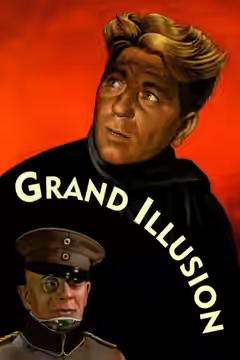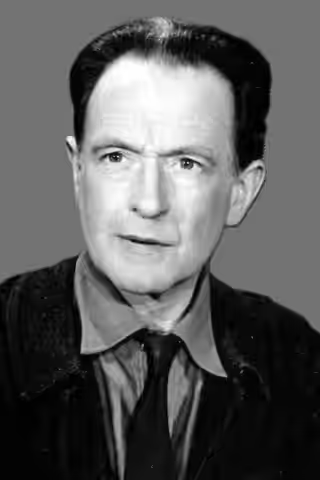
Pierre Fresnay was the French cinema's officer class: a Comédie-Française voice, a straight back and a face that gives away almost nothing, which is why the little it gives away counts. Renoir used him better than anyone else did.
Fi1m perspective
Captain de Boëldieu wears a monocle and white gloves in a German prison camp and speaks to his men as if reading from a card. That is how Pierre Fresnay enters Grand Illusion (1937), and for a while it looks like a joke at his expense. Jean Gabin's Maréchal, hands in his pockets and cap pushed back, is the man we are meant to like, and the two do not like each other. Fresnay never asks for our sympathy. He keeps the back straight and the vowels clipped and lets the film come round to him.
The voice was made at the Comédie-Française, where he arrived in 1915 and played eighty roles before leaving in 1927. Success on stage as Marius in Pagnol's play in 1929 took him into Marius (1931), then a part for Hitchcock in 1934, then Renoir. Through the forties he was Henri-Georges Clouzot's man twice, as Commissaire Wens in The Murderer Lives at Number 21 (1942) and as Doctor Germain in Le Corbeau (1943), and by Monsieur Vincent (1947) he was playing a saint. Officers, inspectors, doctors, saints, scientists, composers: French cinema knew what to do with him, and it was usually to put him in charge of something.
What he does that other actors do not is speak. The diction is exact without being fussy, every consonant where it should be, and it lets him play authority without raising his voice; a Fresnay character tells you what will happen next and you believe him. The danger is plain. A man that composed can turn into a piece of furniture, and there are stretches of Grand Illusion where Boëldieu is closer to an idea of an aristocrat than to a person. Renoir knows this and uses it: the film needs one man who is all surface so that it can ask what a surface is for.
We expected to find him absurd and we did not, and it was the gloves that did it. He wears them as if they were still required somewhere, and the longer the film goes on the less funny that becomes, for reasons we will not describe. Gabin gets the warmth of the film and Marcel Dalio gets its generosity. Fresnay gets the thing nobody else in it could have played, a man doing his duty to a world that has already gone.
He directed one film himself, in 1941, and ran the Théâtre de la Michodière with Yvonne Printemps, his most frequent co-star, until 1974. We have only the one review to send you to, and it is the right one. See Grand Illusion first, for him and for everyone around him, and notice how little he has to do to hold his end of it.
Biography
Pierre Fresnay, born Pierre Jules Louis Laudenbach, was a French stage and film actor. Encouraged by his uncle, the actor Claude Garry, he trained at the Paris Conservatoire and joined the Comédie-Française as a pensionnaire in 1915, later becoming a sociétaire before leaving in 1927. He appeared in more than 130 plays and over 70 films.
Fresnay is known for his stage and screen performances as Marius in Marcel Pagnol's trilogy, including the films Marius (1931), Fanny (1932) and César (1936). He played Captain de Boëldieu in Jean Renoir's Grand Illusion (1937) and appeared in Alfred Hitchcock's The Man Who Knew Too Much (1934) and Henri-Georges Clouzot's Le Corbeau (1943). He maintained a long professional partnership with actress Yvonne Printemps, with whom he appeared in several films between the 1930s and 1950s.