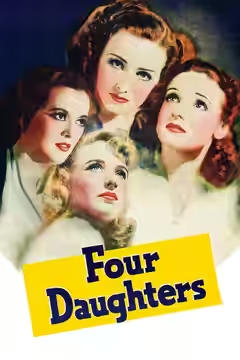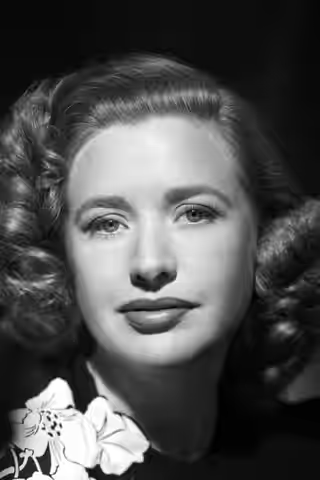
Priscilla Lane played sunshine for Warner Bros. and played it well, and the studio rarely asked her for anything else. Watch her listen to a man at a piano in Four Daughters and you see what it wasted.
Fi1m perspective
The best thing Priscilla Lane does in Four Daughters (1938) is sit still. Ann Lemp has been the sunniest of Adam Lemp's four musical daughters, and Lane plays sunshine easily, but when John Garfield's Mickey plays his own unfinished piece and Ann listens, Haller holds the camera on her face and something in it goes quiet. We were moved more than we expected to be by a scene that is only a man at a piano and a woman on a chair. It is the first time the film admits that being happy in that house might not be the whole of a life, and it is Lane who admits it, not the script.
She came to pictures singing. From 1931 she and her sisters Rosemary and Lola worked as a singing and comedy act with Fred Waring's Pennsylvanians, and Warner Bros. signed her and Rosemary after Varsity Show (1937). Four Daughters was the breakthrough, and the studio kept the Lemp family going through 1941. Michael Curtiz, who directed her three times, treats the sisters in that first film as a set: they enter in a row, wear complementary frocks by Orry-Kelly and hand lines to one another like a relay. Lane is the one who steps out of the row, and only because Garfield gives her something to look at.
The rest of her Warner years follow the pattern that film set. She is Jean Sherman opposite James Cagney and Humphrey Bogart in The Roaring Twenties (1939), and she is in Blues in the Night (1941). The parts are supporting or co-starring, beside established men, and the character is nearly always the wholesome girl next door or the fiancée who waits. It was noticed at the time that the studio used her as a stooge to its male leads, and we think that was a fair complaint. She was sincere on screen in a way that is harder than it looks, and sincerity is a real talent and a hard one to sell.
Her contract ended by mutual agreement in 1942, and freelancing gave her two leads of a kind Warner had not offered: Pat Martin, the heroine of Alfred Hitchcock's Saboteur (1942), and Elaine Harper opposite Cary Grant in Frank Capra's Arsenic and Old Lace (1944). We have not reviewed either, so we will only say they are the films to look at if you want to know what she did when a picture was built around her rather than around the man beside her. Two more films in 1947 and 1948, and then she stopped, and stayed stopped.
Start with Four Daughters, and do not watch it for the plot, which is soft, or for the sisters as a group, which the film never quite separates. Watch the parlour, and wait for the piano. Lane spends most of the film being pleasant and most of a career being pleasant, and for a minute or two on that chair she shows what Warner had under contract and did not use.
Biography
Priscilla Lane (born Priscilla Mullican) was an American actress and singer. The youngest of the Lane Sisters, she began performing as a child and toured with her sister Rosemary in Fred Waring’s orchestra, the Pennsylvanians, from 1931. After appearing with the band in the 1937 film Varsity Show, she signed a contract with Warner Bros.
She is known for her roles as Ann Lemp in the family dramas Four Daughters (1938), Daughters Courageous (1939), Four Wives (1939) and Four Mothers (1941), as well as The Roaring Twenties (1939), Saboteur (1942) and Arsenic and Old Lace (1944). Lane retired from film after Bodyguard (1948) and later hosted a local television programme in Boston in 1958.