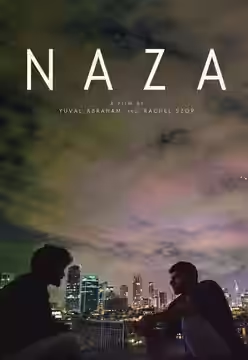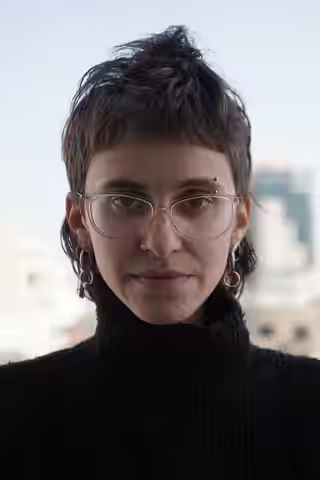
Rachel Szor films people in the dark and the places they talk about in the light. Two features in, both made with Yuval Abraham, she has a method rather than a style, and in NAZA (2026) it produced a film as frightening as anything we have watched in years.
Fi1m perspective
A man sits on a rooftop in Tel Aviv at night. His face is in shadow. Behind him the windows are lit, there is traffic on the roads and the skyline could belong to any prosperous city on a warm evening. He is describing how the killing in Gaza was organised. That is NAZA (2026), and the arrangement of the shot is Rachel Szor's: the speaker dark, the city bright, the place he is talking about a short drive away and out of frame. It is a simple idea and she does not decorate it.
Szor came to directing from journalism rather than film school. She started in visual journalism around 2017 and learned on the job, as cinematographer and editor on No Other Land (2024), the collective documentary about the destruction of villages in Masafer Yatta that she made over five years with Basel Adra, Yuval Abraham and Hamdan Ballal. We have not reviewed it and will not judge it here. But the habits people noticed in it are the ones we saw in NAZA: patience in low light, a handheld camera that stays close during a conversation, and an interest in the system rather than the single crime. She has put it plainly herself: "we were interested in the system, not in some sort of a crime that a soldier is doing."
That interest shows in what she leaves out. NAZA is 80 minutes long, has no score to speak of, and is mostly men talking. Szor and Abraham, editing together, keep the pace even and cut often enough between the dark speakers and the lit city that the contrast stops being a device and becomes the point. We found the film as frightening as anything we have watched in years, and the reason is that arrangement: these men are safe, above the city, in the dark, and the place they are describing has been flattened. Abraham asks short questions and does not help. Szor gives him nowhere to hide and the men nowhere to look.
It is journalism first and cinema second, and we would not pretend otherwise. The film depends on its testimony, drawn from 24 intelligence and military personnel, and the camera's job is to hold still and not get in the way. Anyone hoping for pictures to admire will find one composition, repeated. It is the right one, but it is one.
Every frame Szor has directed has been shared with Abraham, and on No Other Land with two more. That is how the work gets made: insider access on one side, the camera on the other. It also means we have not yet seen a Rachel Szor film, only films she is part of. On the evidence so far she seems content with that, and more interested in the system than in the signature.
Biography
Rachel Szor is an Israeli film director, cinematographer, editor and investigative journalist. She co-directed the documentary No Other Land (2024) with Basel Adra, Hamdan Ballal and Yuval Abraham. The film, which she also co-wrote, filmed and edited, won the Academy Award for Best Documentary Feature.
Szor co-directed, wrote, filmed and edited her second feature, NAZA (2026), with Yuval Abraham. It premiered at the Venice Film Festival, where it received the Special Jury Prize. Born in 1994, she is also an activist whose work centres on the Israeli–Palestinian conflict.