Raoul Walsh made films that move: men crossing deserts, gangsters on the way up or down, a microphone carried into the open in 1928. He knew when a story was thin and kept it walking so nobody would notice.
Fi1m perspective
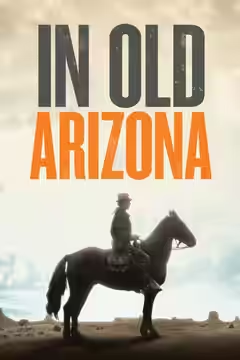
Listen to In Old Arizona (1928) before you look at it. Hooves on dirt, cattle, eggs going into a pan: Raoul Walsh and Irving Cummings carried a microphone out of the studio and pointed it at a desert, when a sound film still meant a man in a dinner jacket standing near a curtain. Warner Baxter's bandit is good company. The film around him is slow, stagey and thin, and we were held more by the sizzle of a frying pan than by anything the plot did, because the pan was new and the plot was not.
He had been at it a long while by then. He acted for D.W. Griffith and assisted him, and was in The Birth of a Nation (1915), the same year he began directing features of his own. The silents that made his name were big and outdoors, The Thief of Bagdad (1924) with Douglas Fairbanks and What Price Glory (1926). In 1930 he made The Big Trail, a widescreen western that gave John Wayne his first leading role. Then Paramount, and from 1939 Warner Bros, where he spent a quarter of a century on gangsters, wars and westerns, finishing with A Distant Trumpet in 1964.
Ask what he did and the answer is that he kept people moving. Critics have called his films journey pictures, stories that go from one point to another and stop when they arrive, shot in deep focus with panning cameras so that the people in them stand in a real, measurable place. Walsh put it more bluntly to an interviewer in 1972: "Outdoor stuff, adventure, things that would keep the picture moving. I didn’t like indoor films." The Warner years gave him actors who could move too. He directed James Cagney five times, in The Roaring Twenties (1939) and White Heat (1949) among them; Humphrey Bogart three times, including High Sierra (1941); Errol Flynn three; Victor McLaglen three. Sidney Hickox photographed several of them.
The knock against him has always been that he was a genre man, bound to the conventions he worked in and given less careful attention than directors who made a show of their thinking. There is something in it. He did not make films that announce themselves. But critics who have gone back to White Heat find more feeling under the action than the action lets on, and we would rather a director who hid his feelings in the running about than one who stopped the film to explain them.
If In Old Arizona is the only Walsh you see, you will have seen him standing still, which was the one thing he could not bear. He is better met on the road.
Biography
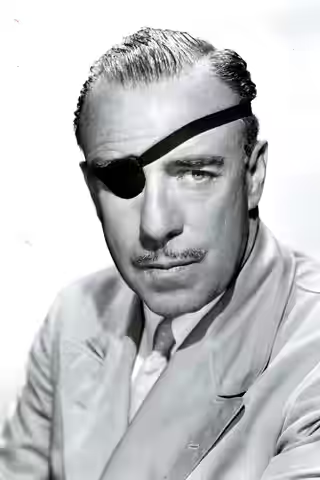
Raoul Walsh (1887–1980) was an American film director and actor. He began directing in the silent era and continued into the 1960s. Walsh was set to direct and star in the early sound Western In Old Arizona (1928), but an accident on location cost him his right eye and ended his acting career.
He is known for directing The Big Trail (1930), The Roaring Twenties (1939), High Sierra (1941), They Died with Their Boots On (1941) and White Heat (1949). Walsh played John Wilkes Booth in D.W. Griffith's The Birth of a Nation (1915). He was a founding member of the Academy of Motion Picture Arts and Sciences and the brother of silent-film actor George Walsh. His last film as director was released in 1964.