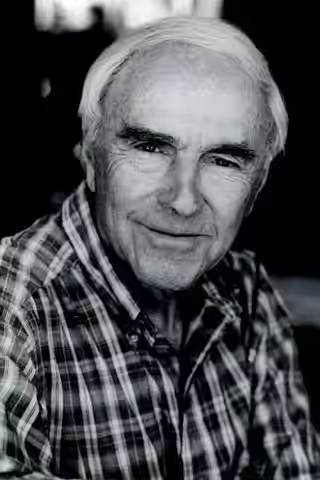
Richard Fleischer could hold a picture together in a train compartment or a bloodstream, and the studios rewarded him by asking for bigger and slower. The lean true-crime films are where his reputation rests; the roadshow musicals are where he did as he was told.
Fi1m perspective
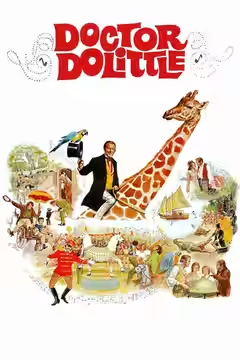
The moment in Doctor Dolittle (1967) that tells you most about Richard Fleischer is not one he planned. A number is running its full length, the camera has sat back to take in the whole set, and the animals, who cannot be directed, do what they like, so the scene ends in a scramble of fur and feathers with nobody in charge. Fleischer's gift was keeping order. The Narrow Margin (1952) does not waste a minute, and Fantastic Voyage (1966) keeps a whole crew inside a human body without losing track of anyone. Ask him to make things larger and slower and he did, and the order went with it.
He came up at RKO in the mid-1940s, shorts and B-pictures after newsreels and documentaries, and the early features were mostly low-budget noirs and crime dramas. 20,000 Leagues Under the Sea (1954), for Disney, changed the scale of what he was offered, and from then on the studios handed him epics, musicals and star vehicles, Kirk Douglas twice, Charlton Heston twice. After a period away, Fantastic Voyage put him back in work, and the last stretch of the career was genre films for Dino De Laurentiis into the late 1980s.
Running alongside all this is the strand that interests us most: the true-crime films. Compulsion (1959) takes on the Leopold and Loeb case, The Boston Strangler (1968) tells its story in split screen, and 10 Rillington Place (1971) is the British one. Fleischer shot them in a semi-documentary manner, and it suits him; a real murder does not need dressing up, and a director who prefers to stand back and keep things straight is what it needs. Soylent Green (1973) has some of the same grimness. We have not reviewed these, so we will not judge them at length here, but they are the films his admirers reach for and we understand why.
The complaint that follows him is that he had no signature, that he was a competent journeyman doing what producers wanted. We think that is half right. Doctor Dolittle is the case for the prosecution: handsome sets, a working menagerie, Rex Harrison at his driest, and 151 minutes on the strength of one good song. By the end we were counting them, and we resented it, because the man who made The Narrow Margin plainly knew better and had decided not to argue. What the complaint misses is that keeping a large production upright is a skill, and a rarer one than it looks.
Fleischer once said that you have to be egotistical to be in the business, that you cannot be shy and retiring about yourself. It is an odd thing to hear from a director whose films almost never draw attention to who made them. Start with the murders, not the musical.
Biography
Richard Fleischer was an American film director whose career spanned more than four decades. Born in Brooklyn, New York, he was the son of animator Max Fleischer. He graduated from Brown University and attended the Yale School of Drama before beginning his film work at RKO in the early 1940s, directing shorts and documentaries. He produced the Academy Award-winning documentary Design for Death (1947).
Fleischer's first feature was Child of Divorce (1946). He directed a range of films across genres, including the science-fiction features 20,000 Leagues Under the Sea (1954) and Fantastic Voyage (1966), the historical epics The Vikings (1958) and Tora! Tora! Tora! (1970), and Doctor Dolittle (1967). Other notable works include Soylent Green (1973), The Boston Strangler (1968) and 10 Rillington Place (1971). He died in Woodland Hills, California, in 2006.