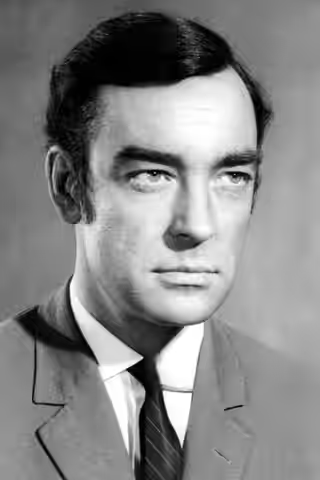
A still, courteous, well-spoken actor whom the 1960s tried to turn into a leading man. He could make authority believable and only rarely made it exciting, and The Haunting shows both in the same tweed jacket.
Fi1m perspective
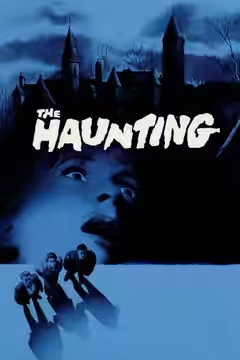
Richard Johnson stands still. In The Haunting (1963) his Dr John Markway walks into the house with a tape measure and a theory, and while Julie Harris comes apart in whispers around him he explains, in paragraphs, what a haunting is. He barely raises his voice. He barely moves his hands. It is the habit of a stage actor who has learned that the audience will come to him, and on film it reads as calm at best and as a lecture at worst. We sat forward every time Harris opened her mouth and back every time Markway produced the tape, because Robert Wise's film stops dead for him and starts again once he has gone.
The stillness was learned properly. He was in John Gielgud's company in 1944 and spent the later 1950s at the Shakespeare Memorial Theatre, becoming an Associate Artist of the Royal Shakespeare Company on its formation in 1960; Peter Hall directed him more than once and Mark Antony was among his parts. An MGM contract from 1959 brought Never So Few (1959), then The Haunting, and the rest of the decade arrived in the shape the studios thought fitted him: Giles in Jack Clayton's The Pumpkin Eater (1964); a colonel in Khartoum (1966) opposite Charlton Heston; and Hugh Drummond in Deadlier Than the Male (1967) and Some Girls Do (1969), Bulldog Drummond pictures made in the wake of Bond.
He had turned Bond down himself, and his account of it is clear-eyed: "Eventually they offered it to Sean Connery, who was completely wrong for the part. But in getting the wrong man they got the right man, because it turned the thing on its head and he made it funny." He had the looks, the voice and the ability, and the charge against him in the sixties was that he lacked the spark to carry a film on his own; in the Drummond pictures the word was stolid. He made authority believable because he never looked bothered by it. But a script has to give him something to be unbothered by. Gidding's screenplay gives Markway explanations, and a man calmly explaining is a man calmly boring us; the same stillness set beside a wall that knocks might have been frightening.
From the 1970s he went into character parts and television. He filmed his RSC Cassius in Julius Caesar (1970), produced as well as acted in Turtle Diary (1985), and was still working as the grandfather in The Boy in the Striped Pyjamas (2008) and as Leonard in Radiator (2014), which he counted among his best and which arrived around his death in 2015. Start with The Haunting and watch Harris around him; then notice how much the film needs somebody who will not flinch, and how little it finds to do with him once it has one.
Biography
Richard Johnson was an English actor, writer and producer. Born Richard Keith Johnson on 30 July 1927 in Upminster, Essex, he trained at the Royal Academy of Dramatic Art and made his professional stage debut in 1944.
He became an associate artist with the Royal Shakespeare Company from its founding and appeared in numerous Shakespeare productions. His film roles included Dr. John Markway in The Haunting (1963), Colonel Stewart in Khartoum (1966) and parts in The Pumpkin Eater (1964) and Scoop (2006). He also worked extensively in television, with credits including Murder, She Wrote and Magnum, P.I..
Johnson turned down the role of James Bond and later produced films through United British Artists. He died on 6 June 2015 in Chelsea, London.