Richard Wilson spent his working life beside Orson Welles and ended it reconstructing him. His own westerns and crime pictures have barely been looked at; the one film of his we have reviewed is useful, well cut and too fair to be angry.
Fi1m perspective
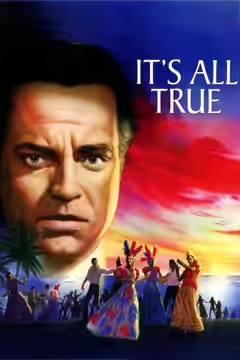
The pictures that justify It's All True (1993) were not shot by Richard Wilson. They are Orson Welles's, from 1942: fishermen on a raft, Carnival in Rio with Grande Otelo grinning through the middle of it, a boy and a bull in Mexico. Wilson's contribution is the other half, the seated interviewees, lit evenly and looking a little past the lens, explaining how the footage came to spend fifty years in a vault. He had been on the original shoot. It is the only film of his we have reviewed, it was finished after he died in 1991, and it is a fair place to start, because it is about the thing his whole career was about, which is standing next to Orson Welles.
He stood there from the 1930s, as actor and stage manager with the Mercury Theatre, on stage and on radio, and then in the early films, Citizen Kane and The Magnificent Ambersons. After the war and a spell producing at Universal he began directing his own pictures in 1955 with Man with the Gun, which he also wrote, and for a decade turned out westerns and crime films of modest size: Al Capone (1959), with Rod Steiger; Pay or Die (1960), which has since been credited with pointing the way for Scorsese and Coppola; Invitation to a Gunfighter (1964), his script again. We have not reviewed them and will not pretend to a view. What we can say is that his reputation has never got out from under Welles's, and that critics have had little sustained to say about the films he made on his own account.
It's All True suggests why, and it is not lack of ability. Wilson wrote it with Myron Meisel and Bill Krohn, Ed Marx cut it to a brisk 89 minutes, and Gary Graver shot the talkers so plainly that nobody looks at the framing, which is the right decision. The account is clear, the archive is well chosen and the story of Ambersons being recut while Welles was in Brazil is told with authority. But the film is so careful to be fair to everyone that it never says what it thinks happened, and the studio men who shelved the reels are barely named. We reached the end wanting someone, and Wilson above all, to be angry on Welles's behalf, and nobody was. A man who had spent fifty years being loyal to a difficult genius had earned the right to a grievance and declined to use it.
He said in 1963 that "Orson is the world's greatest living director. But he doesn't always make the best pictures." That is the whole of him in two sentences: devoted, clear-eyed, and unwilling to press the point. Start with It's All True, for the raft and for the account. Then, if the 1950s crime picture is your kind of thing, the rest is waiting to be looked at properly, which is more than most people have done.
Biography
Richard Wilson was an American director, writer, producer and actor. Born in McKeesport, Pennsylvania, he studied at the University of Denver and began his career as a radio actor with Orson Welles’ Mercury Theatre.
He served as associate producer on several Welles films, including The Lady from Shanghai (1948) and Macbeth (1948). As a director he is known for Man with the Gun (1955), Al Capone (1959) and Invitation to a Gunfighter (1964). Wilson also directed, wrote and produced the 1993 documentary It's All True: Based on an Unfinished Film by Orson Welles, completed after his death with collaborators Bill Krohn and Myron Meisel.