Orson Welles put the camera on the floor and let ceilings press down on men who thought they were bigger than their houses. The films he was allowed to finish are among the best America has made; the rest are fragments, some of them remarkable.
Fi1m perspective
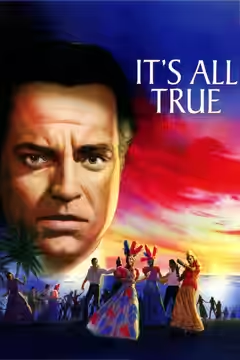
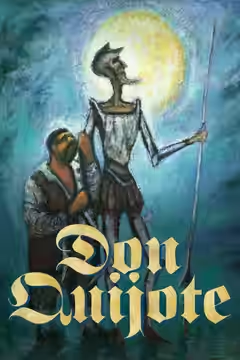
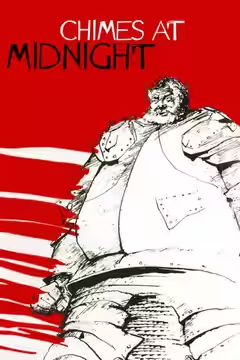
The camera is on the floor. In Chimes at Midnight (1965) Edmond Richard shoots the tavern from the boards with a wide lens, so the beams press down and Falstaff fills the frame like furniture. In Don Quixote the camera is down among the sheep when the Don charges them, low and fast, dust everywhere. In the 1942 footage of It's All True, George Fanto shoots four fishermen from low on the sand so they stand against enormous skies. Welles liked people to look larger than the houses they stood in, and then he liked to show you the houses winning.
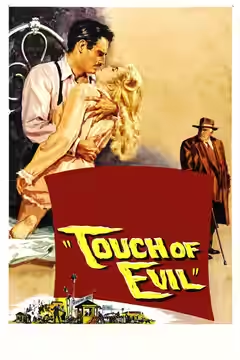
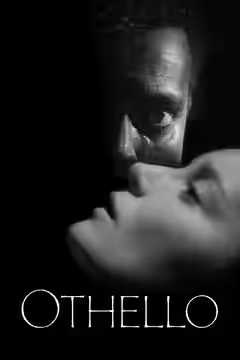
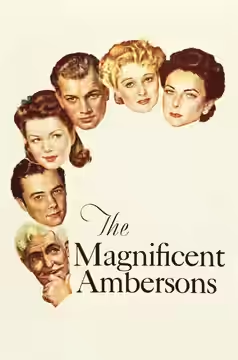
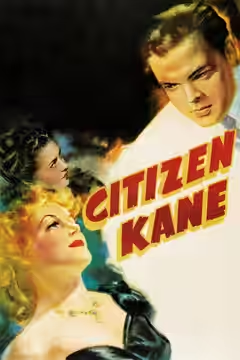
He arrived at RKO in 1939 with a contract that gave him unusual control, and spent it on Citizen Kane (1941), which he directed, co-wrote and starred in. Gregg Toland's deep focus keeps near and far sharp, so a scene has more than one thing to look at. Then the control went. The Magnificent Ambersons (1942) was cut by around forty minutes while Welles was in Brazil shooting It's All True, which the studio abandoned. He lost the studio soon after. From the late 1940s he worked mostly in Europe on whatever money turned up: Othello (1951) was shot over years in pieces, Chimes at Midnight ran short, Don Quixote was never finished. Touch of Evil (1958) was a late return to Hollywood.
What survived intact is as good as its reputation, and Welles's own performances are the surest thing in it. Quinlan in Touch of Evil is broad enough to risk becoming an attraction in his own right, which is what makes his authority believable. His Falstaff is quieter than you expect, the eyes forever going to Keith Baxter's Hal, checking. In the scene where Hal, still playing at being king, says Falstaff will be banished, Welles simply stops, and we found it harder to watch than anything in Kane: it is an old man's face waiting to be told it was a joke.
The failures are mostly things you hear. Othello is dubbed in every line, and it costs the actors. Don Quixote lays voices over mouths filmed years earlier. Touch of Evil plots conspicuously. Welles staged for the eye, and when the money ran out the ear was left to fend for itself.
The reconstructions show what is missing. It's All True (1993) was assembled with respect, which is not what Welles was known for; his cutting was quick and his narration was half the point. Don Quixote (1992) treats every surviving foot as though it must be used. Start with Ambersons and Chimes at Midnight, then Kane, and come to the fragments last, knowing they are somebody else's best guess at what he meant.
Biography
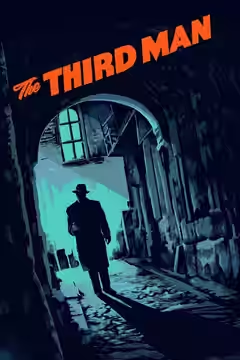
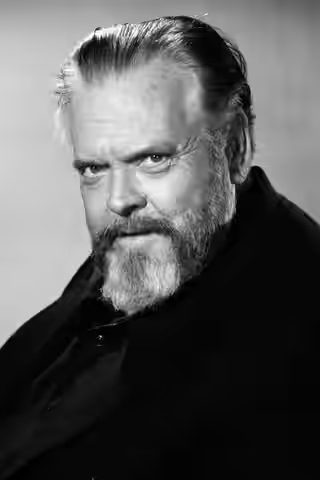
Orson Welles was an American director, actor, screenwriter and producer. He directed, produced, co-wrote and starred as Charles Foster Kane in Citizen Kane (1941). He played Harry Lime in The Third Man (1949).
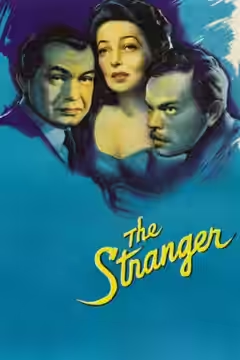
Welles is also credited as director and co-writer on Touch of Evil (1958), The Lady from Shanghai (1947), The Magnificent Ambersons (1942) and Chimes at Midnight (1965). He directed The Stranger (1946) and The Trial (1962).