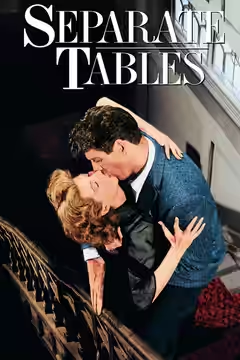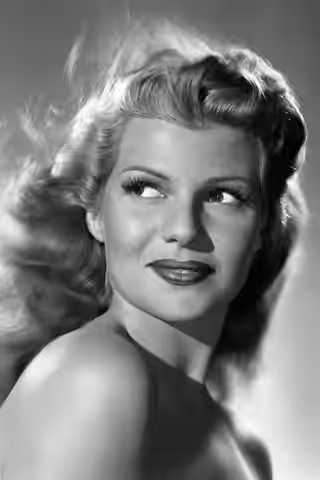
Columbia built Rita Hayworth to be looked at, and the looking was the point: the dancer opposite Astaire and Kelly, the siren in Gilda. When the pictures asked her to talk instead, she was often less well served, and Separate Tables shows both halves.
Fi1m perspective
The best thing Rita Hayworth does in Separate Tables (1958) is keep quiet. Charles Lang holds on her face longer than the script needs, and in those seconds Ann Shankland is a woman who has come a long way to a hotel nobody chose, to reopen something she should have left shut. Then she opens her mouth, and while Rattigan's people say less than they mean, she and Burt Lancaster say everything, twice, at a volume the dining room was not built for. Edith Head puts her in gowns that plainly came from somewhere else. That is the shape of the whole career in one dining room: a face the camera wants to stay on, and writing that keeps interrupting it.
The career was built rather than grown. Born Margarita Carmen Cansino, she danced with her family as a child and made her first film in 1935 as Rita Cansino; Columbia changed the name and dyed the hair, and the studio's Rita Hayworth arrived in musicals opposite Fred Astaire, in You'll Never Get Rich (1941), and Gene Kelly, in Cover Girl (1944). Only Angels Have Wings (1939), with Cary Grant, had already got her noticed. Then Gilda (1946), the part that fixed her for good as the screen siren of her decade, and The Lady from Shanghai (1947) for Orson Welles. She kept leading parts through the 1950s and into the 1960s, and made her last film in 1972.
The dancing with Astaire and Kelly is where the reputation is soundest, and it is earned. The trouble was what came after. Columbia sold her as a pin-up, the 'Love Goddess', and the image decided what parts she got. Once Gilda had happened, the parts kept asking for Gilda, and she said as much herself: she was an actress, with depth and feeling, and the studio wanted only the image. By the 1960s the roles were smaller and fewer.
Which is why Separate Tables matters more than its size. It is a late dramatic part in an ensemble of very good English players, and she is not among the film's successes; she and Lancaster are the half that never fits. But we were moved by her there, more than by anything she was written to say. It was the gown in a room full of cardigans, and the way she wore it as if she knew every diner could see it too. The part hands her a woman to explain rather than a woman to be, and she does what she can with the moments between the explanations.
Start with the Astaire films for the dancing, and Gilda for the rest. Come to Separate Tables last, and when Lancaster starts shouting, do as the residents do and look across the dining room; but look back when Lang does, because that is where she is.
Biography
Rita Hayworth was an American film actress and dancer. Born Margarita Carmen Cansino on 17 October 1918 in Brooklyn, New York, she began performing as a child in her parents’ nightclub dance act. She made her first film appearance as a child and entered feature films in the mid-1930s under her birth name before adopting the screen name Rita Hayworth.
She rose to prominence in the 1940s with roles in films including Only Angels Have Wings (1939), Cover Girl (1944) and Gilda (1946). Hayworth appeared in further notable productions such as The Lady from Shanghai (1947), Pal Joey (1957) and Separate Tables (1958), in which she played Ann Shankland. She was frequently described as a pin-up figure during the Second World War and was known by the nickname "The Love Goddess".