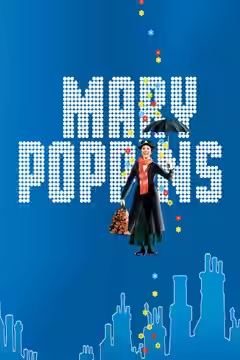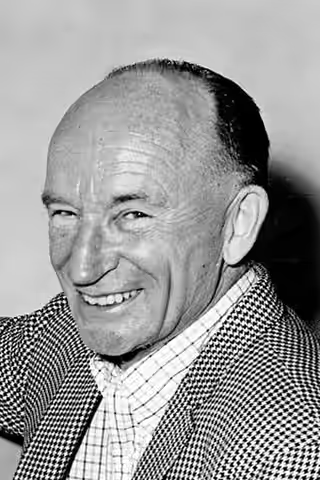
Robert Stevenson directed nineteen live-action films for Disney, and one of them, Mary Poppins (1964), will outlive the rest by some distance. He was a reliable, unfussy craftsman who never seemed to mind that the wires showed, and once that was exactly right.
Fi1m perspective
When Mary, Bert and the children jump into a chalk drawing in Mary Poppins, the actors stroll through a painted countryside among drawn farm animals and the join is plain to see. Stevenson does not hide it and does not apologise for it. That is his habit across twenty years at Disney: put real people next to something that is obviously not real, keep the camera steady and trust the audience to go along. Mostly they did.
He was not always a Disney man. He began as a screenwriter in Britain in the late 1920s and was directing by 1932, with Tudor Rose (1936) and King Solomon's Mines (1937) among nine British features before he left for Hollywood in 1939 under contract to David O. Selznick. Selznick loaned him out for Jane Eyre (1943), with Orson Welles and Joan Fontaine, an atmospheric picture nobody watching The Love Bug would guess was his. Then came wartime documentaries, post-war features and a long spell in television, including Alfred Hitchcock Presents and Zorro, before he joined Walt Disney Productions in 1956. He stayed until he retired in 1976.
The Disney films are the ones people remember, from Old Yeller (1957) through The Love Bug (1968) to Bedknobs and Broomsticks (1971), and they share a recipe: a children's book or story, often with a British flavour; a familiar face such as Dean Jones or David Tomlinson; and a set piece built from effects and animation. The complaint against the later ones is that the recipe hardened into a formula, and we would not argue. Bedknobs and Broomsticks takes the Mary Poppins mixture and Tomlinson and comes out pleasant, and gone by breakfast. The difference is Julie Andrews, the Sherman brothers' songs and a script that is quietly about a father.
Stevenson's own weaknesses are visible in Mary Poppins too. At 139 minutes it runs long, and past the hour he lines up set pieces and lets the story drift while Cotton Warburton lets Step in Time run on past its point. Fifteen minutes could go. But he also lets David Tomlinson's frightened banker be wrong for the better part of two hours before the film corrects him, and we found ourselves more moved by that stubborn, anxious man than by anything the chalk drawing did. Not many directors of children's films would have held that nerve, and Stevenson is not usually credited with nerve at all.
He said once that what he had in mind when directing was a happy audience, enjoying itself in a cinema. It is a modest ambition and he met it more often than most. Start with Mary Poppins. If the rest of the shelf feels like the same afternoon repeated, that is because it is.
Biography
Robert Stevenson (31 March 1905 – 30 April 1986) was a British-American film director and screenwriter. Born in Buxton, Derbyshire, England, he studied at Cambridge University before beginning his career in the British film industry.
After directing several British features, including King Solomon's Mines (1937) and Jane Eyre (1943), he moved to Hollywood. From 1956 he directed 19 live-action films for Walt Disney Productions. He is best known for the musical Mary Poppins (1964), for which he received an Academy Award nomination for Best Director, as well as The Love Bug (1968), Bedknobs and Broomsticks (1971) and Herbie Rides Again (1974).