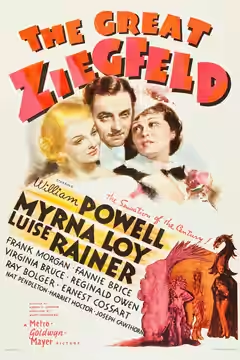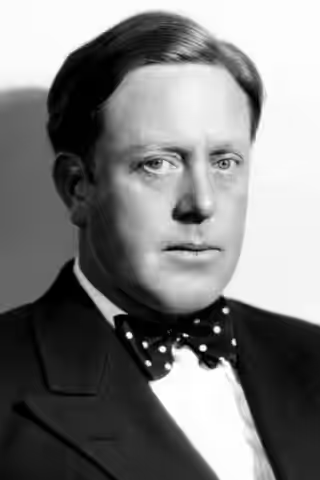
Robert Z. Leonard spent more than thirty years at MGM putting the studio's money and its stars on screen in good order, and doing little else. The films are handsome, well cast and rarely his; The Great Ziegfeld shows both the gift and its limit.
Fi1m perspective
Near the middle of The Great Ziegfeld (1936) a curtain rises on a staircase that keeps going up, dressed with more women and more satin than any Broadway stage could have held, while 'A Pretty Girl Is Like a Melody' plays and plays. That is Robert Z. Leonard at his most himself. Give him Hunt Stromberg's money and a number to build and he will build it bigger than the man he is filming ever managed. Give him the 185 minutes of biography around it and he gets to them when he remembers. Lavish where it counts and slack everywhere else, we said of the film, and it will do for the career.
Leonard came to directing from acting, at Selig Polyscope in 1907 after abandoning law, and was directing by 1913. He spent 1915 to 1919 at Universal with Mae Murray, co-founded Tiffany Productions, and joined MGM in 1924, where he stayed for more than thirty years. There he made what the studio needed: musicals, light comedies, star vehicles and period adaptations. The Divorcee (1930) and Dancing Lady (1933) come from the early stretch; then the operettas, five in a row with Jeanette MacDonald and four with Nelson Eddy, Maytime (1937) among them. In 1940 he was brought in late on Pride and Prejudice, which is noted for playing Austen as screwball comedy. He left MGM in 1955 and made two more films by 1957.
The gift was management. Leonard was the director MGM sent when the production was large and the star was difficult, and the films show it: the frame is full, the performers stand where they can be seen, and nothing looks cheap. It is a real skill and it leaves almost no mark. Most critics have never put him near the front rank, and the musicals are commonly dismissed as decoration. We think that is half right. We were bored through long stretches of Ziegfeld, honestly and increasingly, and then Luise Rainer picked up a telephone and for a few minutes the film had a person in it rather than a staircase. That scene is the best case for him: he could tell what was worth watching, even if he could not always tell what was worth cutting.
Leonard himself said in 1935 that the director had begun as "a sort of adventurer-magician". By then he had been at MGM eleven years and was neither; he was the man who got the thing made. If you want to know what a studio director looked like when the studio was at full strength, start with Ziegfeld, keep a thumb near the fast-forward, and stop when the curtain goes up.
Biography
Robert Z. Leonard (7 October 1889 – 27 August 1968) was an American film director, producer, actor and screenwriter. Born in Chicago, Illinois, he began his career in the theatre and entered the film industry as an actor around 1908 before turning to directing in 1913.
He spent much of his career at MGM, where he directed a series of successful musicals and dramas. His credits include Dancing Lady (1933), The Great Ziegfeld (1936), Pride and Prejudice (1940) and In the Good Old Summertime (1949). He was nominated for the Academy Award for Best Director for The Divorcee (1930) and The Great Ziegfeld, the latter of which won the award for Best Picture.
Leonard received a star on the Hollywood Walk of Fame for his contributions to motion pictures. He was married to actress Mae Murray from 1918 to 1925 and to actress Gertrude Olmstead from 1926 until his death.