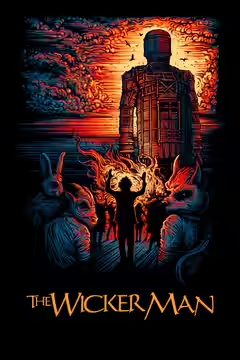
With The Wicker Man, Robin Hardy made folk horror funny and inviting without making it comfortable. We rate it highly because he takes the islanders’ beliefs seriously and lets us enjoy their company longer than feels wise.
Fi1m perspective
The islanders in The Wicker Man (1973) can sing, explain their customs and treat a policeman’s objections as faintly ridiculous without ever looking like conventional villains. Robin Hardy lets them be pleasant company, which is why his horror works so well. Edward Woodward’s Sergeant Neil Howie brings stubborn Christian conviction to his investigation of a disappearance on a remote Scottish island. Hardy takes him seriously while allowing us to find him difficult.
We laughed at Howie’s discomfort, then felt uneasy about having joined in, because Hardy makes the islanders easy to enjoy without giving us reason to feel safe. Anthony Shaffer’s screenplay keeps the enquiries moving while the disagreement over belief becomes harder to dismiss. Eric Boyd-Perkins’s editing helps Hardy move between folk songs, comedy and the police investigation without losing track of what Howie is trying to establish. The songs belong to the community; Hardy does not treat them as a pause in the horror. At 93 minutes, it gives us time to find the island attractive without exhausting the enquiries; we remain curious about what Howie will learn next.
Hardy’s feature career was sparse. After The Wicker Man, he worked in commercials and on historical theme parks, before directing his second feature, the Irish-set psychological thriller The Fantasist (1986). The Wicker Tree (2011), which he wrote and directed from his novel Cowboys for Christ, was a spiritual successor to The Wicker Man. His interest was in making pre-Christian religion plausible as the basis for a contemporary society, rather than keeping its rituals safely in the past.
There is stiffness in The Wicker Man, especially when people seem to be waiting for their turn to explain what they believe. Hardy does not always make Shaffer’s more explanatory dialogue sound like conversation. Yet we would not want the humour tidied away to make room for more obvious menace. It matters that Howie can be irritating and his hosts agreeable: the dispute would be much less troubling if supporting him were easy. Start with The Wicker Man, and resist any temptation to have its later developments explained beforehand.
Biography
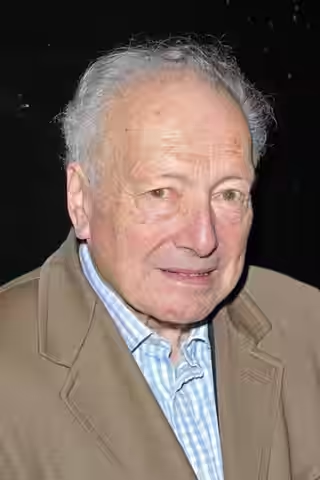
Robin Hardy was an English film director and author. He directed The Wicker Man (1973), a folk horror film written by Anthony Shaffer and starring Edward Woodward and Christopher Lee. He later directed The Fantasist (1986) and The Wicker Tree (2011), the latter an adaptation of his own novel Cowboys for Christ.
Hardy was born Robin St. Clair Rimington Hardy on 2 October 1929 in Wimbledon, London. He studied art in Paris and began his career directing for the National Film Board of Canada and educational television programmes in the United States. Returning to Britain, he co-founded an advertising agency with Anthony Shaffer and collaborated with him on The Wicker Man. He also wrote historical novels, including a novelisation of The Wicker Man.
Hardy died on 1 July 2016 in Reading, Berkshire. He was survived by his fifth wife, Victoria Webster.