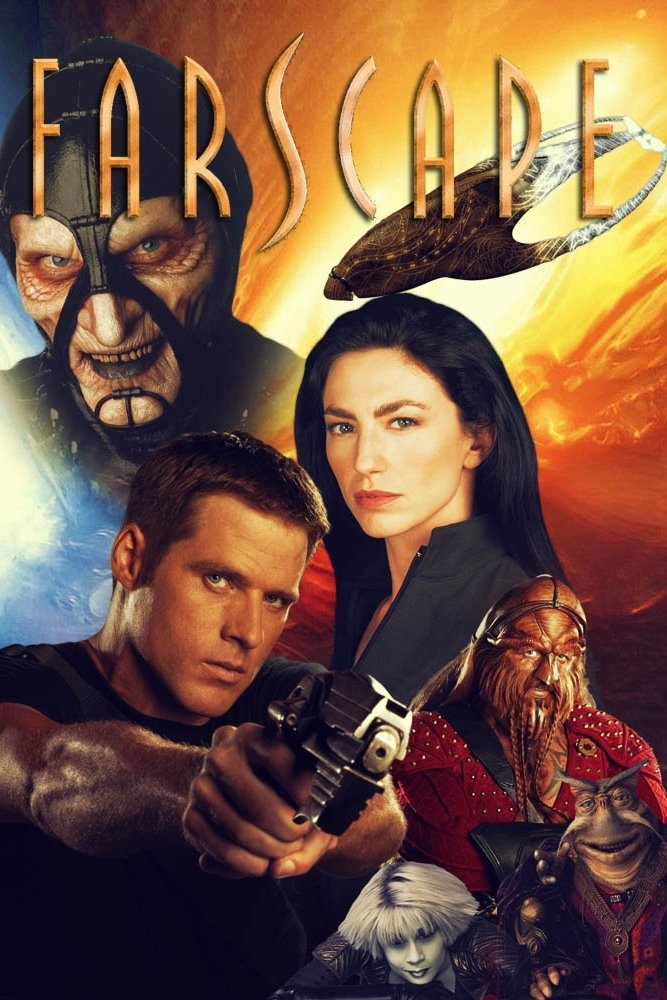
Rockne S. O'Bannon's science fiction is at its best when the creatures are strange and the company is difficult. We recommend Farscape for the relationships that develop from that friction, with some patience required for the early melodrama.
Fi1m perspective
In Farscape (1999), the strange creatures share the screen with characters who are not easy company. O'Bannon's series makes friction within the ensemble part of the continuing story, rather than something to clear away before the next adventure. We grew fond of this lot because their relationships became more involved, even when the early melodrama made them hard work. That is reason enough to persevere with a programme whose effects have visibly aged.
The route there runs through his screenplay for Alien Nation (1988), with its alien immigration premise, and the underwater science fiction of seaQuest DSV (1993), which he created. These are settings built to accommodate more than a single story, a useful instinct in a television writer. Farscape ran for four series, followed by a miniseries in 2004.
We should not give him sole credit for what works. Across his work, collaborators include Brian Henson, a co-developer, director and producer, and David Kemper, a writer and executive producer. The useful habit in O'Bannon's writing is to let disagreements drive the drama, giving the ensemble something to do beyond explaining its surroundings. Yet Farscape also shows how readily conflict becomes melodrama when we have not had time to care about the people involved.
The later work tests other ways of drawing an audience into an invented setting. Defiance (2013), which he developed and wrote, tied its world-building to a video game. Cult (2013), which he created, took a darker interest in fandom, prompted by his experience of the following around Farscape. That is a revealing turn: the audience's attachment had itself become material for a series.
We would still send the curious to Farscape first, rather than promise that every large premise pays off equally well. Its appeal depends on being willing to stay with people who are not immediately agreeable, and on accepting some conspicuous roughness along the way. Give the relationships time to develop. If the early melodrama is more than you can bear, the creatures alone may not compensate.
Biography
Rockne S. O'Bannon is an American television writer, screenwriter and producer, working primarily in science fiction. He created the series Farscape (1999–2003), on which he also served as writer and executive producer, as well as seaQuest DSV (1993–1996) and the film Alien Nation (1988).
O'Bannon began his career selling spec scripts to Amazing Stories (1985) and The Twilight Zone (1985), later becoming a staff writer on the latter. He has written for and produced other series including Constantine (2014), Revolution (2012), Defiance (2013), Cult (2013) and Evil (2019). He has received multiple Saturn Awards, including for Farscape.