Rouben Mamoulian makes movement, music and speech work together, and we rate him most highly when that ingenuity gives the actors room. Love Me Tonight is our starting point: a warm, funny musical with a slight story.
Fi1m perspective
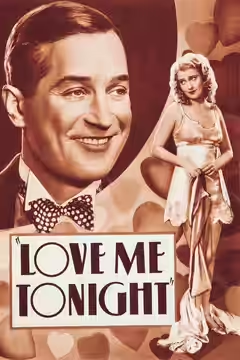
Love Me Tonight (1932) moves between dialogue, song and action without making the changes feel laboured. Mamoulian, both director and producer, gives Maurice Chevalier and Jeanette MacDonald room to let the attraction develop. We were touched by their vulnerability, which makes this slight courtship worth caring about. There is little dramatic urgency, and the lovers themselves are not especially surprising. We recommend it readily, with the warning that its pleasures depend on enjoying their company.
His first feature, Applause (1929), had already used a mobile camera and multi-microphone sound techniques. Dr. Jekyll and Mr. Hyde (1931) explored first-person camerawork and synthetic sound. Mamoulian was interested in letting us see and hear from a character's position. He also understood how movement and sound could give a scene its rhythm. Those interests make more sense together than as a list of technical firsts.
In Love Me Tonight, Richard Rodgers and Lorenz Hart's songs belong within the action rather than interrupting it. Mamoulian shares the editing credit with William Shea, and the lightness of the cutting helps the romance take its time without becoming stiff. Nothing about the aristocratic company persuades him to make the telling ceremonious. He allows tenderness to matter as much as the joke. We value that patience because it gives the performers something to do besides keep pace with the music.
With Becky Sharp (1935), the first three-strip Technicolor feature, colour became another means of shaping the drama. In Blood and Sand (1941), compositions inspired by Spanish painting accompany a romance prone to cliché and dramatic stiffness. His films do not always make the people as interesting as their surroundings. Theatre continued alongside the films, and Silk Stockings (1957) was his final completed feature. Start with Love Me Tonight, on an evening when there is no great hurry.
Biography
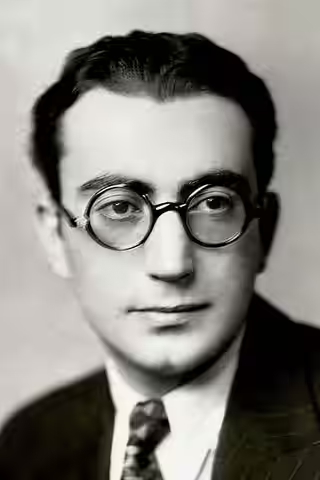
Rouben Mamoulian was an Armenian-American film and theatre director. Born in Tiflis in the Russian Empire, he trained at the Moscow Art Theatre and worked in theatre in London before moving to the United States in 1923. He directed stage productions including the original Broadway Porgy (1927) and began his film career with Applause (1929).
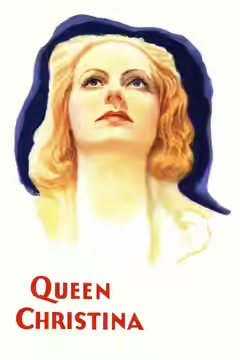
In Hollywood he became known for innovative use of sound, camera movement and integration of music in early talkies. His credits include City Streets (1931), Dr. Jekyll and Mr. Hyde (1931), Queen Christina (1933) and The Mark of Zorro (1940). He produced, directed and edited the musical Love Me Tonight (1932), which featured songs by Rodgers and Hart. Mamoulian also directed the first Technicolor feature Becky Sharp (1935) and later Blood and Sand (1941) and Silk Stockings (1957). He died in 1987.