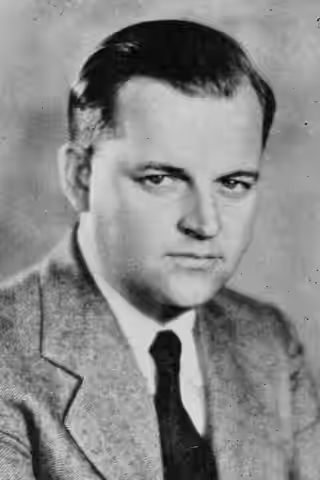
Roy Del Ruth spent four decades getting out of the way. His films move fast, trust their stars and stop the moment the number is over, which makes them as good as whoever is in front of the camera and rarely better.
Fi1m perspective
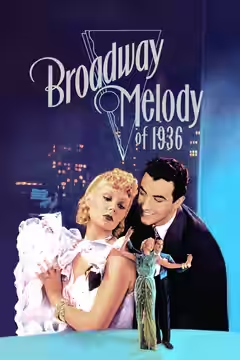
In Broadway Melody of 1936 (1935) there is a producer, a rich backer, a gossip columnist making trouble and a girl from out of town who can dance, and Roy Del Ruth directs the lot as though the plot were a corridor between rooms. The rooms are where the numbers are. When Eleanor Powell starts to tap he stops hurrying and lets her go. We sat through the story with the patience you keep for a warm-up act, and then Powell danced and we forgot there had been a story; she is the reason to see the film, and Del Ruth's contribution is to know it.
That is the whole of his method, and it was learned early. He wrote gags for Mack Sennett from 1915 and was directing comedy shorts by 1919, and a man trained that way knows a scene has one job and should leave once it has done it. Warner Bros. took him on for features in 1925 and he made more than fifteen in four years, including early sound musicals. Through the 1930s, at Warners and then MGM, he turned out pre-Code comedies, crime pictures and musicals at a rate that would look careless if the films did not move so cleanly. He directed James Cagney four times, in Blonde Crazy (1931) among others, and made the first screen version of The Maltese Falcon (1931), with Ricardo Cortez, a decade before John Huston's. Employees' Entrance (1933) is the pre-Code drama of his that people still talk about.
The move to MGM meant Powell, three films' worth, including Born to Dance (1936), with Cole Porter's songs and James Stewart in the cast. The musicals show both sides of him. He does not decorate a number or cut across it; he frames the dancer and stands back, which is the right decision and also the only one he seems to have. When the star is Powell that is plenty. When the material is thin, nothing of his own arrives to fill the gap, and the films are exactly as good as the people in them.
The later years thin out. It Happened on Fifth Avenue (1947) is a holiday comedy with some warmth in it, often set beside It's a Wonderful Life. The Babe Ruth Story (1948) has a reputation for being rushed and loose with the facts that we have not felt moved to test. There was low-budget horror, The Alligator People (1959), and then Why Must I Die? (1960), after which he stopped.
He was a studio director in the plain sense: fast, tidy, unbothered by posterity. Start with Broadway Melody of 1936, and if you find yourself reaching for the remote during the dialogue, he would not have blamed you; on the evidence, he felt much the same.
Biography
Roy Del Ruth (also credited as Thomas LeRoy Ruth) was an American film director. He began his Hollywood career in 1915 as a gag writer for Mack Sennett and directed his first short films in the late 1910s before moving to feature films in the 1920s.
He directed musicals and comedies at Warner Bros. and MGM, including Broadway Melody of 1936 (1935), Born to Dance (1936) and Broadway Melody of 1938 (1937). Other credits include the 1931 version of The Maltese Falcon and segments of Ziegfeld Follies (1945). He received a star on the Hollywood Walk of Fame.
Del Ruth died on 27 April 1961 in Sherman Oaks, California.