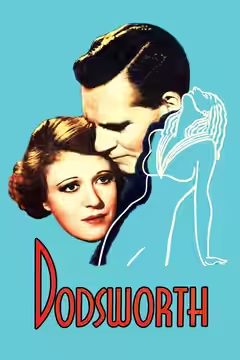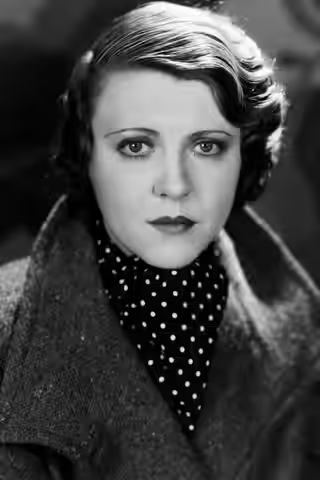
Ruth Chatterton came to talking pictures from the stage with a trained voice and a taste for women who are hard to be in a room with. In Dodsworth (1936) that makes her the performance some viewers cannot stand, and we think she is right.
Fi1m perspective
Fran Dodsworth sits at a dressing table in a hotel and looks at her face, and for a second Ruth Chatterton lets us see how frightened she is of what she finds there. It is one of the few quiet moments William Wyler gives her in Dodsworth (1936), and it is the key to what she does. Fran wants to be taken for thirty, and Chatterton pitches her high and keeps her there for the whole film. She does not soften her. She plays the vanity at full volume and hides the fear underneath it, and the viewer who finds her hard going has understood the part exactly.
She was a stage actress first, on Broadway from 1911 and a leading lady after Daddy Long Legs in 1914, and she did not make a film until Sins of the Fathers in 1928, when she was thirty-five. Sound arrived at the right moment for her. She had the diction for it, and Paramount put her into a run of melodramas about strong, suffering women: Madame X (1929), Sarah and Son (1930), and Female (1933), in which she plays a powerful, sexually assertive factory head. We have not reviewed those and will not judge them here, but the pattern is plain enough: women in charge, or women who want to be, put through torment. After 1934 the studios lost interest as she aged and the vehicles got thinner. Dodsworth was the exception. She made two more films in Britain and had left the cinema by 1938.
What works is the stage intensity, when the film knows what to do with it. On the ship in Dodsworth, Sam Dodsworth stands at the rail calling for his wife like a boy who has spotted the English coast, and Fran is below, bored, being charmed by David Niven. It moved us more than we were ready for, because Chatterton plays that boredom as plainly as Walter Huston plays that happiness, and neither of them is wrong about the other. What does not work is the weather around her. Wyler gives Huston his quiet scenes and gives her almost none, and when Maria Ouspenskaya arrives for a single drawing-room scene, the cruellest in the film, Fran has nowhere to stand. Chatterton reportedly saw Fran as a flatter, simpler woman than Wyler did and fought him over it. On the evidence she lost the argument, and the film is better for it, though she carries the loss on screen. Mary Astor, sitting still and speaking slowly as Edith Cortright, is doing the opposite of her in every scene, and the contrast is the film.
Start with Dodsworth and expect to dislike her; that is the job, and she does it without asking to be forgiven. The Paramount melodramas kept her suffering. Wyler let her cause the suffering instead, and she was better at it.
Biography
Ruth Chatterton was an American stage, film and television actress. She began her career as a chorus girl and became a Broadway star in Daddy Long Legs (1914). She made her film debut in Sins of the Fathers (1928) and appeared in numerous films during the early 1930s, including Madame X (1929) and Sarah and Son (1930).
Chatterton is best known for her performance as Fran Dodsworth in the 1936 film Dodsworth. Her film career declined after the mid-1930s; she returned to the stage and later appeared in several television productions from the late 1940s. In the 1950s she published several novels. She was also a licensed pilot.